serene – 3, part 20

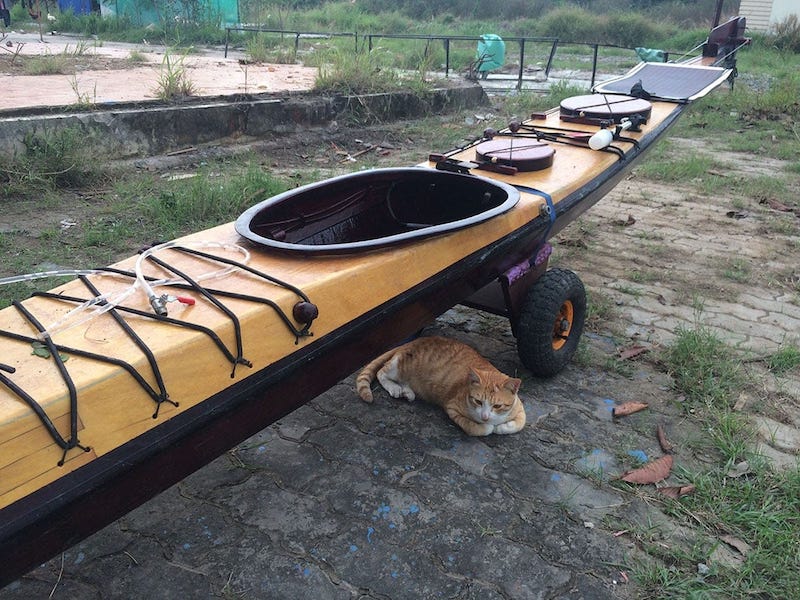
Deck and hull jointed, for almost the entire length, almost no additional glueing is needed, almost a perfect fit, no light seen through. Only around the cockpit, the widest part of the boat, needs some fillet to fill some small gaps. However, as a precaution, I applied some little additional fillet at places along the gunwales to make sure the joint is really secured. Now trimming the deck to match the hull, cut the slot on top of the rudder box, round the seam lines to facilitate glassing later.

Next, the whole hull and deck receive some sanding to smoothen out their surfaces, erase all the pencil and sketch pen marks. Those sketch pens offer very good indications, though they’re a bit hard to be erased off the plywood. Sanding is just a slow and dirty job, and it’s very itchy. The ugliest part of S & G boat building is sanding on fiberglass, it produces dust, which is essentially just tiny particles of silica sand, and those are extremely itchy, I have to take a bath 2, 3 times after the work.

Over the time, I devised a trick to cope with this: rub your exposed body parts with some mineral oil (e.g Johnson’s baby) before doing the sanding job, then taking a bath after would remove those hateful dust easier. This time, I do the sanding job more carefully, one at 100 grit and another at 120 grit before applying the wood staining. This time, I decided to go with a less vibrant color scheme, light brownish for the deck and black for the hull, unlike previous boats with bright yellowish tone.

serene – 3, part 19

Lots of “unnamed” jobs need to be done: slightly modify the rudder (shorten its rotating arms, slightly shorten then rudder blade by 1 cm, add the carabiners for simpler rudder line attachment…), prepare the bilge pump mount, double check to make sure if all electrical wiring works (things made easy with a multimeter: voltage, current, resistence) etc… Then I carefully check the bevel along the gunwales, to make sure the hull and deck would match, adjusting their slopes with an angle grinder.

Then, let joint the two halves of the peanut shell, it’s always a really good feeling when your boat initially is turned into its final shape! I ran out of the very handy and useful 511 putty, and lazy going out to buy a new batch, I fall back to working with wood flour fillet, though wood flour is not as good as the very fine grain powder of 511. Priming the joint with epoxy and some fillet, press the two halves together with weights, duct tapes, clamps, fastening belts… anything that’s convenient.

The deck has not come to its final shape yet since it’s cut oversized in order to have some fault tolerance. Next is the job of trimming the deck to the desired shape, then reinforce the hull – deck joint with some fillet at places, there’re still some small gaps between them that need to be filled. If done properly, it should make air tight (and water tight) compartments inside the hull. Later a layer of hull glassing would overlap about an inch onto the deck, to help securing the joint further.

serene – 3, part 18

After lots of considerations, I made up my mind to implement the electrics – electronics system of this Serene – 3 kayak as simple as possible. There would be no built – in compass and nav lights. Only a set of six 18650 Li-ion battery cells charged from the solar panel, and a reed switch to activate the bilge pump. That would reduce the electrics wiring hassle to minimum, simplify the installation quite a lot. Of course, the compass still needs lighting to be used at night, and the nav light too.

Looking back on the electric, electronics part of Serene – 2, I’ve seen that I’d over – engineered quite a lot, things should be simpler. The compass and nav lights would now be a single hand – held torch, powered by rechargeable AA batteries, I would detail this “solution” in later posts. And the electrics components should be decoupled to facilitate repairing, upgrading. All the wiring runs inside plastic tubes (as additional protection) and can be pulled out of the hull for repair when needed.

So basically, the system composes mainly of Li-ion cells that would have 2 duties: power the bilge pump & the charger that would replenish some AA batteries. The AA batteries would be then used to power the Garmin and the light torch. Also in the waterproof electric box is the USB charger, which could be used for a variety of electronic devices. And I believe most if not all chargers could be modified to use either the 5V (USB) or the 12V (Li-ion) source, would try to check (prove) it later on.

serene – 3, part 17

Next came the rudder box, an interesting idea that I’ve come up with lately. First, when not in use, the rudder would be retracted completely inside the rudder box (and so inside the hull), it would be safer, tidier when transporting, moving the boat around. Second, and more importantly, the rudder box allows mounting the rudder in a lower position, which enables a smaller rudder blade. From the design phase, when drawing a hull with lots of overall rocker (the keel line has quite some curvature)…

I saw that bottom of the stern would barely touch water when the kayak is at full load, hence, it’s good to mount the rudder lower down, about 10 cm lower compare to my previous boat. So I would just reuse my previous rudder with more steering effect. Lessons learnt from Serene – 2 showed me that I need a more responsive rudder, so everything, from the rudder post to the control pedals must be redesigned, shorter “rotating arms” for the rudder, and smaller “moving distances” for the pedals.

For this Serene – 3, I would make the seat position fixed, so the rudder pedals must be adjustable, back and forth about 12 ~ 15 cm. Of course there would be only one paddler for this boat, that’s me, but an adjustable rudder pedals is desirable anyhow, though it’s not very frequently needed. I choose a pedal layout that would let me stretch and relax my legs and feet. Not a surfing boat, rudder is for some slight course adjustment only, I don’t have to rest my feet on the pedals most of the time.

serene – 3, part 16

Hull is rigid like a walnut shell now, I took it out for a slight sanding on the external side before applying extra layers of glass at bow and stern, the two ends that would withstand quite some abuse when landing on unfavorable shores. Then I install the rudder post, a piece of wood that protrudes the flat stern about 7 cm, glued, screwed, filled with putty and then finally two layers of glass. Lots of extra reinforcement for this rudder post, a lamination of 3 different layers of wood.

I carefully choose different types of wood, with different wood grains to make up this simple rudder post. The grains that run in different directions would ensure that this wooden block would be more resilient to forces from various “angles of attack”. Then I install the rudder control tubes, plastic tubes 10 mm in external diameter (6 mm internally), quite large indeed. The large tubes is, for later, I could easily try various types of rudder control cable, to see which works best.

The tubes run just below, and along the gunwales, through the bulkhead, fixed in place using epoxy putty and small strips of plywood. A lesson learnt from my previous boat: fix the tube positions, don’t let them run loose, slightly different port and starboard tubes would result into different tensions on the control lines, or an awkward rudder pedaling control effect. The tubes exit the hull through small slots cut very near to the stern, protected outside by small blocks of wood.

serene – 3, part 15

Now go in the gunwales, bulkheads and thwarts, which make the hull looks more “full fledged”… Indeed, those gunwales, bulkheads and thwarts would transform the hull into a structure, which is much more stiff. Gunwales are thin strips of wood, 1.5 x 3 cm in cross section. I cut all those wooden strips with my small Makita table saw, which is extremely helpful for a wide range of different jobs, especially because it cuts are flat and straight, unlike those made with a hand held jig saw.

The more I use it, the more I discover new techniques and tricks to get some jobs done. Also with the Makita table saw, I bevelled the gunwales, diagonal cuts at 45 degrees along the forward parts of the gunwales. I would adjust those bevelled edges along the boat length later, to better match the hull versus the deck. Now having a total of 32 clamps of different types, I’m able to install the two gunwales, port and starboard at the same time, not one after another like before.

There’re two bulkheads compartmentalizing the kayak into 3 sections, and 3 additional thwarts near the two ends that would help transforming all into a rigid structure. All is glued in places, then reinforced with small 4 cm screws connecting them to the gunwales. Then putty – fill the bulkheads to secure them to the hull, then a layer of glass over on the cockpit side since that’s where they could be potentially exposed to water. Still some more jobs need to be done to complete the hull!

cossacks – 1

Giống như khi phái đoàn ngoại giao Grand Embassy của Sa Hoàng Peter the Great lần đầu tiên sang châu Âu, những ban nhạc cung đình châu Âu biểu diễn âm nhạc cổ điển sang trọng, lịch sự, từ tốn. Để đáp lại, dàn nhạc của Peter biểu diễn một thứ âm nhạc với huýt sáo và hò hét. “Cũng tương tự”, muốn nghe hò hét, huýt sáo trong không gian âm nhạc thính phòng, hãy xem Alexandrov Ensemble biểu diễn tại Anh năm 88, một trong những bài dân ca Slavơ nổi tiếng nhất…

Cossack không phải là một dân tộc riêng biệt, mà chỉ là một sub – culture trong không gian văn hoá Slavơ chung: Nga, Ucraina, Belarus… Từ thời xa xưa, họ sống trên các thảo nguyên, lối sống trồng trọt, chăn thả, giỏi về chiến đấu trên lưng ngựa. Trong tất cả các thời đại, từ thời các Sa hoàng đến thời Sô – viết, và hiện đang thấy rất rõ trong giai đoạn nước Nga Putin hiện đại, Cossack vẫn luôn luôn là “cơ bắp” của chế độ: giữ gìn, mở rộng biên cương, trấn áp nội gian, nội loạn.

serene – 3, part 14

Purchased a new roll of 6 oz fiberglass, also “plain weave” like that was used in my previous boats. Surprisingly, the 2 kinds of fiberglass cloth, both 6 oz and plain weave, are not really the same, the later cloth has finer and denser fiber, it’s slightly heavier, a bit harder to wrap around and it absorbs more epoxy. It’s now time for some glassing, the hull receive a layer throughout its internal side, while the deck is only reinforced at places: around the forward hatch and around cockpit.

In my calculation, glassing adds, on the average, about 0.4 kg per square meter of surface (the glass mass itself plus the epoxy). So, glassing both inside and outside of the hull would add about 2 kg into the boat weight. That’s not really a big issue, as long as the glassing work is done properly, avoid using too much epoxy and keep weight in control. Sometimes, you need to step back and watch for everything you’d done during the past times. It seems that with 5 kayaks, all stitch & glue…

I’m becoming what they usually call: a prisoner of one own experiences, having designed and built several boats again and again using the same methods and techniques. While that’s somewhat true, in each boat, I’ve been trying to incorporate new things, new design ideas, new techniques, new accessories… My thirst for “the perfect kayak” has not been wholly quenched yet! And that “great journey” has not been done yet, lots of things waiting ahead to be full – filled, to be accomplished!

serene – 3, part 13

Deck works continue… installing the anchor points, 12 for the 2 hatches, and another 12 for the lashing bungee cords, and additional 6 at various places along the deck, quite a lot of work. But there’re many other “unnamed” jobs related to the deck still: beveling the cockpit and hatches joints, glassing the cockpit joint, install the bulkhead… I also switch back and forth between the deck and the hull: glassing the hull’s internal seam lines, gluing the wooden blocks at bow and stern, etc…

First image: the anchor points to hold down the forward hatch, 6 pairs of 6 mm holes (both on port and starboard sides) are used to mount the 6 loops of 4 mm paracord, which in turn are used to secure the belt locks. Second image: various anchor points are placed along the deck, some used for the hatches, some used for bungee cords, and some are just “reserved”, those are not readily in use, but provided for lashing things down on to the deck should the need arise.

Third image: wooden block glued to the bow, later a hole would be drilled through to run the kayak’s pulling line. Fourth image: another wooden block glued at the stern, note the two 5 cm screws, to fasten and reinforce the rudder post (would be installed later). The rudder post is another wooden block glued on the external side of the stern, rudder, rudder post, rudder control lines and control pedals, and the “new” rudder box are important issues that would be covered in next posts.

serene – 3, part 12

Next came the hatch locks, each hatch is hold down by 3 belt – locks, similar to those usually found on your backpacks, very secured and easy to lock / unlock. But that would be later on, for now, the locks’ anchor points need to be built and installed. There are many of them (a total of 30), as the anchor points are not only used for holding the hatch lids down, but also for other lashing bungee cords, and they are built exactly as in my Serene – 1 & 2 previous kayaks, a tried and true technique.

A line would (from the external side), go though the “half – circle tunnel” drilled inside the wooden blocks and loop back to the external side of the hull, forming very strong holding points for various lashing lines. I made two MDF templates and cut the grooves with my very handy Bosch router (first image), a set of three anchor points is placed on one same wooden bar (second image), and install as a whole (fourth image) for the ease of installation, just gluing the wooden bars to the deck.

The deck doesn’t receive a layer of fiberglass throughout, it is only reinforced at critical positions: around the cockpit, around the hatches, or along the seam lines, to help keeping the final weight low. But for an “expeditional boat”, weight is not the primary concern, the boat need to have some “mass” to withstand considerable amount of abuse in long paddling trips. I would expect around 20 kg finally! It’s bad that I’d seen the hull flexing a bit under heavy loads with my Serene – 2 kayak!

nguyễn văn minh

Chuyện về thiếu tướng tình báo Phạm Xuân Ẩn (PXA) thì nhiều người đã biết và biết khá nhiều rồi. Nhưng có 1 câu chuyện khác, 1 nhân vật khác cũng ly kỳ không kém, theo một đường hướng hoàn toàn khác.

PXA là 1 điệp viên hạng nhất, điều đó không có gì phải bàn cãi. Sinh ra trong 1 gia đình công chức thuộc địa cao cấp, 1 địa chủ giàu có, được ăn học đàng hoàng. Tham gia CM năm 45, kết nạp Đảng năm 53 bởi chính Lê Đức Thọ, ông trùm nội chính VN, được hướng dẫn bởi bác sĩ Phạm Ngọc Thạch, 1 nhân sĩ được ông Hồ hết sức yêu mến và tin tưởng, được hỗ trợ và chỉ đạo từ Mười Hương, Tư Cang… những nhân vật tình báo chuyên nghiệp (chuyên nghiệp hiểu trong ngữ cảnh VN, chứ chưa thể so với CIA hay KGB được). PXA là 1 điệp viên hạng nhất trên mọi phương diện, định hướng hoạt động tình báo chiến lược từ sớm, được tổ chức gởi đi Mỹ học, làm việc cho những thông tấn xã hàng đầu thế giới như Time và Reuter, có quan hệ với tất cả những nhân vật tinh hoa, chóp bu của giới quân sự và chính quyền miền Nam, các nhân vật tình báo hàng đầu của tất cả các bên như William Colby, Edward Lansdale, Lucien Conein, Bs. Trần Kim Tuyến…

Còn Nguyễn Văn Minh (Ba Minh – NVM) sinh ra trong một gia đình nghèo khó đông con, chỉ mới học hết lớp 5, gia cảnh khó khăn và sức khoẻ kém, đã từng muốn vào chiến khu tham gia CM nhưng không thực hiện được (cũng vì lý do sức khoẻ). Cho đến năm 54, cái gọi là “hoạt động CM” của ông chỉ dừng lại ở mức “cảm tình viên” ở cấp quận, huyện, chủ yếu là cung cấp những tin tức thuộc loại làng nhàng. Hoạt động tố Cộng, diệt Cộng của Ngô Đình Diệm những năm 55, 56 làm nhiều tổ chức, đường dây bị vỡ, NVM mất liên lạc suốt gần 10 năm. Một số lần đường dây được nối lại, nhưng rồi lại đứt. Những hoạt động của ông giai đoạn đầu chưa thể xem là tình báo, chỉ mới ở mức độ thông tin cấp thấp. Năm 55, ông học đánh máy chữ, chủ động bán nhà lấy tiền hối lộ để được vào làm nhân viên đánh máy ở Bộ tổng tham mưu chế độ cũ, hàm “thượng sĩ nhất”. Đây là bước đi đầu tiên chứng tỏ ông có một kế hoạch, một bài bản để làm tình báo chuyên nghiệp.

Trong suốt 18 năm, từ 1955 đến 1973, NVM tìm cách nối lại đường dây liên lạc với tổ chức, nhiều lần không thành công. Một số lần thành công thì cái vị trí, cấp bậc quá thấp của những người trong đường dây làm cho những tin tức của ông không được đánh giá đúng, mặc dù theo như lời NVM, ông đang “ngồi trên một núi vàng”, vì rõ ràng cái vị trí dù chỉ là nhân viên đánh máy trong Bộ tổng Tham mưu cho phép NVM tiếp cận với những thông tin thuộc loại tối mật. Không mất kiên nhẫn, trong suốt 18 năm đằng đẵng, NVM tìm cách liên hệ và chờ đợi cái ngày mà người ta đánh giá đúng những thông tin mà ông có thể cung cấp! Không biết chắc là vì những lý do gì, nhưng mãi cho đến cuối năm 1973, mạng lưới điệp báo A.3 mới chính thức được thành lập, và 1 dòng chảy thông tin trực tiếp từ Bộ tổng Tham mưu được hình thành. Người ta bắt đầu đánh giá đúng về giá trị của tình báo viên NVM, dù chỉ trong khoảng 1 năm rưỡi cuối cùng của cuộc chiến.

Nhà nghèo với 10 đứa con, lương của một “thượng sĩ nhất” không đủ nuôi chừng đó miệng ăn. Nhưng ngày nào ông cũng làm việc 15, 16 tiếng chép tay lại toàn bộ thông tin để đưa ra ngoài. NVM học thêm tiếng Anh chừng 1 năm để có thể copy được tài liệu tiếng Anh, và như ông có nói: tôi ít học, không đủ trình độ để phân tích, đánh giá thông tin, tôi chỉ làm 1 việc nhỏ nhoi, nhưng làm rất tốt! Có lần, tổ chức đưa 200 000 để ông mua chiếc xe máy để tiện cho việc đi lại, liên lạc. NVM mua chiếc xe Honda 67 hết hơn 100 000, trả phần còn lại! Sau này được hỏi về hành động đó, sao không giữ lại tiền mà nuôi 10 đứa con, ông trả lời: “tôi không bán tin, tôi cũng làm CM như các anh thôi!” Cách trả lời cho thấy ông ấy hoàn toàn ý thức về vai trò cũng như giá trị của một điệp viên hạng nhất! Chất lượng của những thông tin ông ấy cung cấp không phải bàn cãi, khi sau 75, người ta thăng anh “thượng sĩ” lên đại tá, và trao tặng danh hiệu Anh hùng lực lượng vũ trang.

Tóm tắt về nhân vật, để thấy rằng NVM không có những gì PXA có: không sinh ra trong 1 gia đình truyền thống giàu có, không được học hành đầy đủ, thậm chí không có được sức khoẻ tốt! Không được “giác ngộ cách mạng” với những nhân vật lão thành hàng đầu như Lê Đức Thọ, Phạm Ngọc Thạch, không được hỗ trợ bởi 1 đội ngũ điệp báo hạng nhất như Mười Hương, Tư Cang, không được định hướng và đào tạo về hoạt động tình báo bài bản từ sớm như PXA. NVM khởi đầu chỉ là một “cảm tình viên” cấp quận, huyện, và hầu như không có một tiếp xúc, định hướng, huấn luyện nào về nghiệp vụ tình báo! Đôi lúc có cảm tưởng rằng, mọi đường đi nước bước là tự ông ấy tính toán lấy, từ việc vào làm ở Bộ Tổng tham mưu, cho đến việc móc nối, chờ đợi 18 năm để người ta có thể hiểu đúng giá trị của mình! Và thậm chí có cảm giác rằng, trong nhiều năm, người ta không tin tưởng NVM, có thể vì ông ấy không nằm trong diện được đào tạo, được “quy hoạch”.

Sự thực là suốt 20 năm hoạt động tình báo, NVM chưa bao giờ là Đảng viên, ông chỉ gia nhập đảng CS sau 1975, 1 bước “thủ tục” cần thiết để có thể thăng ông ấy lên đại tá và trao tặng danh hiệu Anh hùng. Nhiều sự việc nằm ngoài hiểu biết của tôi, hay có điều gì “một nửa sự thật” mà ngành tình báo đến giờ vẫn không thể nói ra!? Trong suy nghĩ của tôi, điều đó gần như là không thể, khi con 1 nhà lao động nghèo ít học, không có được bất kỳ tiếp xúc gì với các thành phần “lý tưởng”, “tinh hoa CM”, gần như không được hướng dẫn, hỗ trợ bởi một tổ chức! Gần như là đơn phương, đơn tuyến, tự mình vạch ra đường đi nước bước, tự mình liên hệ và chờ đợi để người ta hiểu đúng về giá trị của những thông tin mà mình cung cấp! Lòng yêu nước “thuần thành” hay còn điều gì khác!? PXA đã là 1 câu chuyện ly kỳ, NVM là 1 điều kỳ diệu! Dân tộc VN tồn tại được qua nhiều biến động của lịch sử vì có những điều kỳ diệu chưa thể được lý giải đầy đủ như thế!

serene – 3, part 11

Continue working on hatches. First image: the completed two hatches (still without the gaskets inside) with the hatch rings (rounded rectangle in shape, cut from a sheet of MDF and strengthen with quite a lot of epoxy). Second image: the recessed (flush deck) forward hatch, the deck is cut 1 inch down, and about 45 cm along the length to get a wider space to install the hatch. This part of the deck is quite weak, and need to be reinforced with some putty and fiberglass inside.

The hatches’ size look a bit small, 18 x 38 cm internal (cut out) side, but that’s sufficient to let many things through, e.g: water bottles or the tent bag, most objects are of long and narrow shapes. I intentionally try to keep the hatch size small as possible, to help with waterproofness. Third image: gluing the forward hatch ring onto the deck, the recessed base is about 1 inch lower, so that when the nearby hatch (seen on the right) is closed on, it would flush with the rest of the deck surface.

The same is done with the rear hatch (not shown here, but you can see it with the image album link on the left). Good thing is that the hatches and their rings fit together really well. Next I would round the internal side edge of the hatches’ ring a bit, cover them with a layer of glass. Completion to the very details in required indeed, in the last trip, I accidentally damaged one of my clothing bag, trying to pull it out of the cramped storage compartment over this sharp, unrounded edge.

serene – 3, part 10

Hull and deck parts are basically stitched and glued, those two halves of a peanut shell. But that’s only a basic milestone, lots of jobs required still to make this shell functional. I continue to build the hatches and cockpit coaming, and various other accessories. 3rd image: the cockpit coaming glued in, stained with epoxy filled with black color pigment, later on, some layers of transparent PU paint would make the finish. While the cockpit is easy, it’s a bit more complicated for the hatches.

Both two hatches is of the same shape and size, for the sake of easy constructing (the hatches and their silicone gaskets). The forward hatch is built recessively into the deck, not only to keep a flushed, flat deck, but also simply because the hatch size is a few centimeters larger than the deck’s top, it needs to sink down to fit. It’s a bit tricky to build the recess, so I decide to get along with a rectangular approach (it’s much easier to build, though a circular one would certainly looks much better).

The aft hatch raises about 1 inch from the deck, not too high to interfere with reentry climb – in actions. I would try a new idea for hatch locking, something that’s easy to operate and tight enough (offer some pressure down) to secure the hatches in places and help with waterproofness. Hatches and hatch locks have been causing my headache for long, but it seems, the best solution is indeed simple, I wonder why my common – sense has not come up with it in the first place.

russian names

100 năm (1917 – 2017), từ Vladimir đến Vladimir… Vladimir đầu là Vladimir Ilyich, Vladimir sau là Vladimir Vladimirovich! Cách đặt tên của người Nga có chỗ khác biệt với phương Tây, ngoài họ (như Ulyanov) và tên (như Vladimir), tên đầy đủ của người Nga còn chèn thêm tên của bố – patronymic ở giữa, như trường hợp của Lenin là: Vladimir Ilyich Ulyanov.

Ở đây, ám chỉ là ông Vladimir, con của ông Ilya, họ nhà Ulyanov, còn của Putin là: Vladimir Vladimirovich Putin (vì bố ông ấy cũng tên là Vladimir). Cách đặt tên như thế có ưu điểm là khó có 2 người trùng tên nhau, nhưng thường chỉ dùng tên đầy đủ trong trường hợp trang trọng (hoặc nghiêm trọng). Thêm một chỉ dấu của một nền văn hoá cực kỳ… phụ hệ!

serene – 3, part 9

That’s the stitch part (of “stitch and glue”), or more precisely, most of it (since there’re still the bow and stern pieces to be put in, but that would be discussed later on), next come the gluing. First the seam lines are “primed” with epoxy (applied with a small brush), then filled with fillet (the tried – and – true 2 – parts epoxy putty 511 that I’ve been using extensively). The “gluing” part is a very time – consuming job, you have to meticulously fill the putty, which slowly flow down under its own weight.

So I have to apply the putty in 2 turns, first fill in just a small bit of them, wait for it to cure, then fill over the first layer another time. This is to ensure that the putty could form curved seam lines that would be easier to glassed later on. You can also mix small batches of putty, wait for about 30 minutes for it to cure partially, then apply it on the seams, the higher viscosity of the slightly – cured putty enables it to better keep its shape. In all, it’s a very time – consuming (and dirty) job!

Next come in the bow and stern pieces. These small triangular plywood pieces need to be bended into curved shapes (see the 4th images below). I simply put them into boiled water for them to soften a bit, then slowly and carefully bend them with a pincer. The bow and stern parts are then temporarily fixed in place with hot glue and duct tape, then permanently glued with epoxy and fillet (putty). Now, the whole hull is rigidly glued in its internal side, similar job is applied to the deck part.

serene – 3, part 8

Itook great care in aligning a bilge’s parts, to make sure the final piece would come exactly to it designed shape, and to make sure the port and starboard bilges are identical, or else, the boat would have a twisted hull. All joints is slightly sanded, and applied a layer of glass on the internal side. Next come the job of putting everything together using a combination of fastening wires, super glue and duct tape. Having experiences from previous boat, I used very little steel wires this time.

It’s so good to see the bilges fit naturally into their position, with minimum pressing, adjusting efforts. The tendency to take shape easily proves that you’ve all done right in the previous steps: measuring, drawing, cutting and jointing the biges. This is for the first time, you would have an initial impression, of how the boat would finally look like. The computer 3D renderings are too small to have a precise assessment, and of course, it’s always much more lively with a tangible object!

Looking at these two halves: hull and deck, having a senses of every details, it’s easier to arrange and schedule the next tasks. There’re so many jobs ahead: make and install the (recessed) hatches, hatches’ locks, install the cockpit coaming, rudder pedals and control lines, compass, the bilge pump, etc… and of course the whole complex electric & electronic system. Things should be better done this time, with the lessons learnt (tediously and expensively) from previous boat projects.

serene – 3, part 7

In parallel to cutting, jointing the bilges and forming up the hull and deck parts, I’m also making the cockpit coaming and hatches. They both use the same techniques of bending thin strips of plywood (2 layers of them) around a MDF frame to form the lips’ shape. Now that I have some much better – quality plywood sheets, which is not too easy to crack while bending into extreme curves, this enables me to construct the cockpit coaming and hatches in a much easier and convenient way.

Both 2 hatches would be of the same shape and size, a “rectangular” with 2 circular ends (or could be called: a rounded rectangular). The hatches’ lips and the coaming lips are built up from 2 layers of 4 mm plywood strips, glued together. The flexibility of the ply serves well to the building, the lips take up shape easily, and stay in that shape steadily. In all, they’re all simple really constructions. Special thing about the hatches this time is that they would have elastic silicone gaskets inside.

Recently, I’ve learnt about silicone molding, using 2 – parts silicone mixed together just like epoxy. So I would mold the gaskets specially to accommodate the hatches, and would describe that in another following post. Hatches’ waterproofness has long been a serious issue to me, hopefully, I could resolve it completely this time. An handy (last resort) trick could also be useful: cover a layer of (very thin) PE plastic over before closing the hatch, that would make it absolutely water – tight.

CMT10

Vài trăm năm trước, Marx đã vẽ ra một cơn “ác mộng” về cuộc sống dưới chế độ TBCN, nơi mọi thứ sản xuất ra là để mua bán, đổi chác. Năng lực sáng tạo của con người bị biến thành một thứ hàng hoá. Sản phẩm và người làm ra sản phẩm rút cuộc cũng đều là một thứ hàng hoá, và cuộc sống hàng ngày bị biến thành một vòng xoáy bất tận.

Vòng xoáy của những zombie – xác sống, vật chất trở nên nửa – sống, còn con người trở nên nửa – chết! Thị trường chứng khoán vận hành như một thế lực độc lập, tự nó quyết định nhà máy nào sẽ mở/đóng cửa, người nào sẽ đi làm/nghỉ ngơi. Tiền thì sống, người thì chết, sắt thép mềm như da, còn da mặt cứng hơn sắt thép! Một vài suy nghĩ của ông ấy vẫn còn tính thời sự!

serene – 3, part 6

Next is jointing the plywood pieces: 8 joints for the hull, and just 1 for the deck, to form the bilges that would build up into the boat shape. For the 2 pairs of hull’s bilges, I flip one pair by 180 degree when drawing on the boards, so that to distribute the joints at different places across the boat length, and not to concentrate too much joints into one proximity. That old boatbuilding carpenter’s trick is not completely necessary with modern building techniques, but it’s nice to do so anyway.

The tried – and – true technique of straight finger joint is used as always. The straight joints are easy to cut, and most importantly much easier to be aligned following a straight line for all the jointing parts, so that to make sure all the bilges would be jointed into the correct shapes. All the joints are treated carefully, first is applying a layer of thinned epoxy (using xylene as a solvent, for the substance to penetrate deeply into the plywood), then gluing with epoxy, then a layer of glass on the internal side.

I beveled the edges of the deck parts a bit (at 45 degrees), so that they would fit tightly and nicely together forming straight seam lines. But that’s not applied to the hull, where the cursive seam lines don’t like very thin edges. Experiences from my previous boats showed that, it’s best just to use the squared edges, the thin edges doesn’t stay on each other very well, and would deform, distort the seam lines! You would later just apply thickened epoxy on both sides (in and out) of the seams!

serene – 3, part 5

The progress is really slow lately, several weeks passed, but little get done! Things started moving anyhow, I “quickly” transfer the “offset tables” onto the plywood boards, draw all the bilges, bulkheads, and other parts. The greatest thing of all is that now I’ve purchased very good sheets of plywood, not truly marine – grade (there’s no such in Vietnam), but high – grade water – resistance ones. I could feel it when do the sawing, the boards are quit tough, not fragile as with my previous ply!

There would be an immediate consequence with the new plywood, I would just use less epoxy to pre – fill the boards, and since the boards is stiffer, the glassing would be done on the outside only, that would significantly save the boat weight, I hope. All drawing is completed quickly, I finished in just less than one day, next come the steps of cutting and jointing the bilges. Everything has been done many times before already, so I didn’t have to think or consider things much, just repeat it!

4th image: the cockpit coaming frame cut from a piece of 18 mm MDF. This cockpit is drawn using the mathematic formula mentioned in my last post. It came very closed to the shape of Serene – 2‘s cockpit, but slightly smaller on each sides by about 5 mm, so my existing spray skirt should fit tightly with this new coaming (on Serene – 2, it’s too tight). The coaming would be constructed from 2 layers of 4 mm plywood, and I would later omit out the (a bit tricky) glass reinforcement on this part!