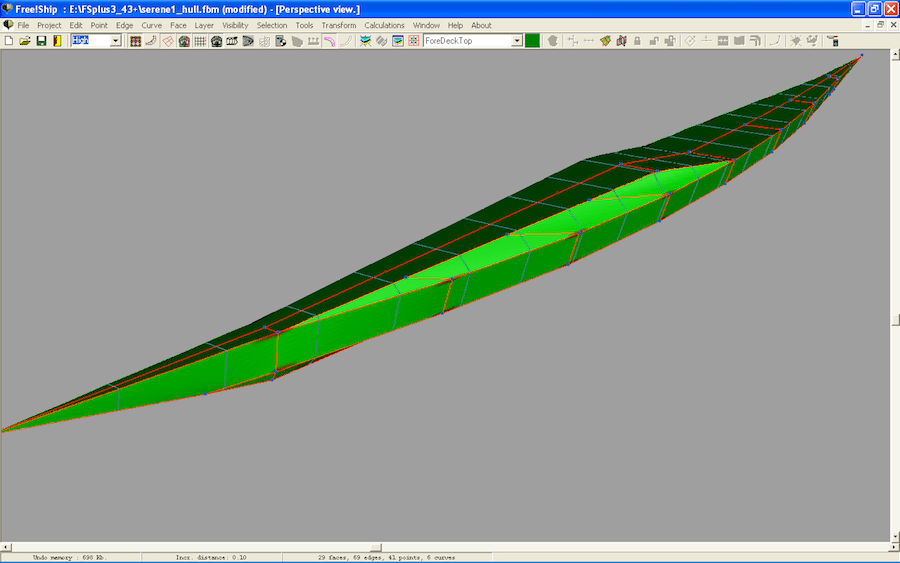
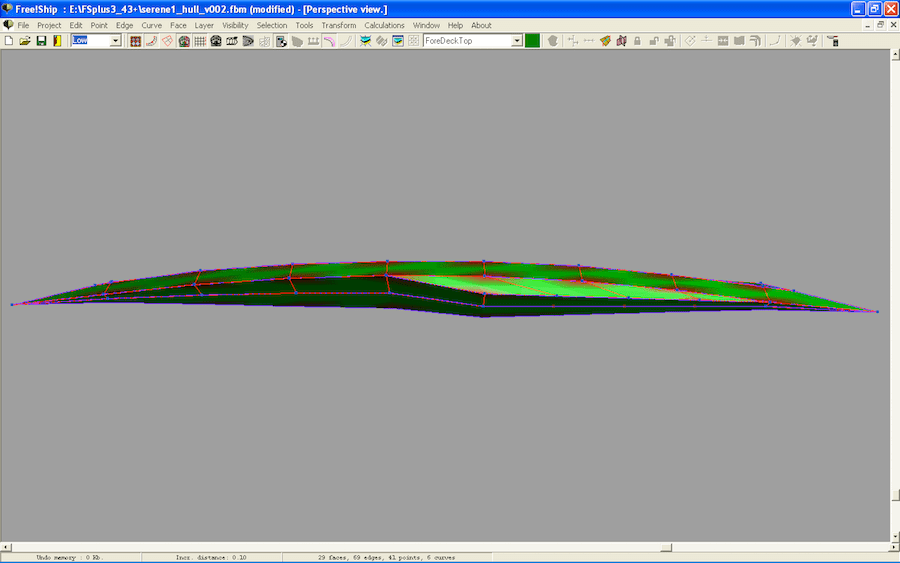
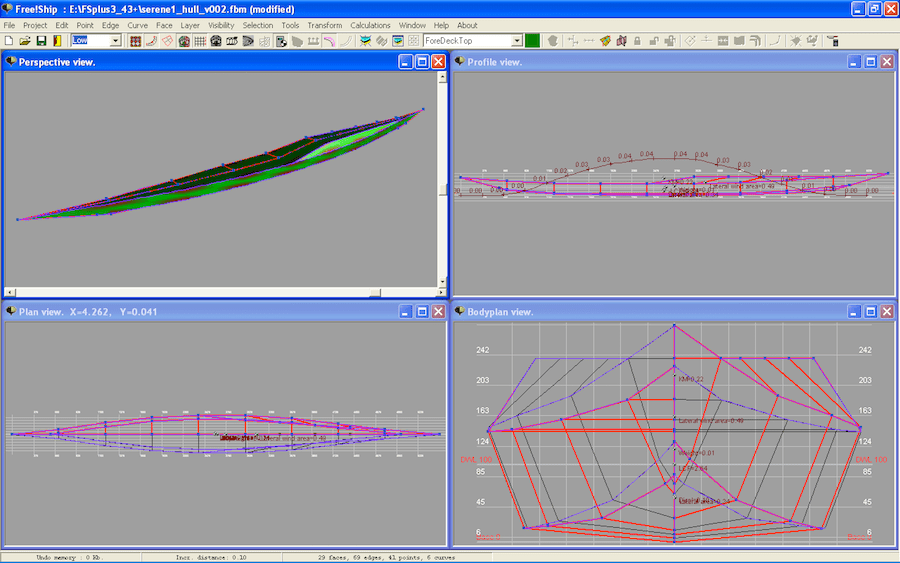
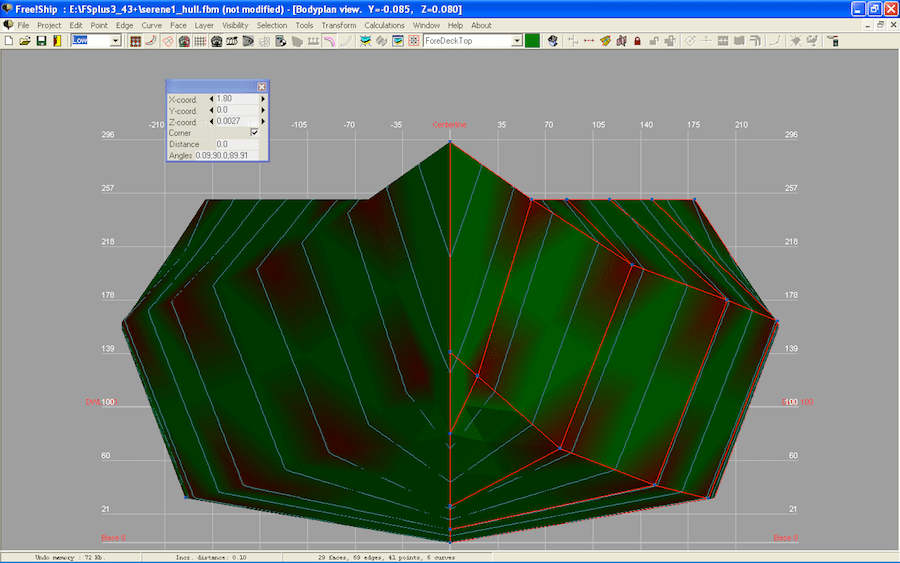
serene – 1, part 7

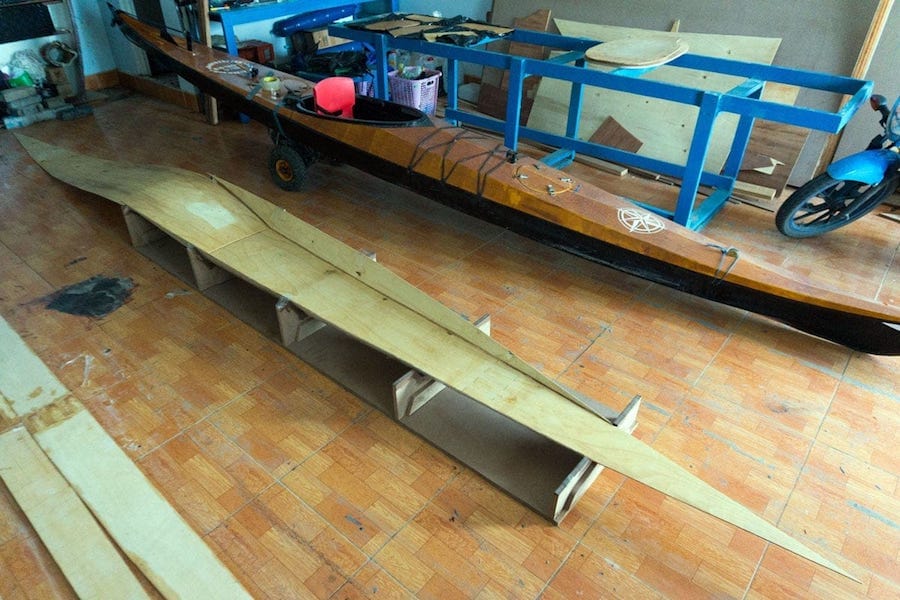
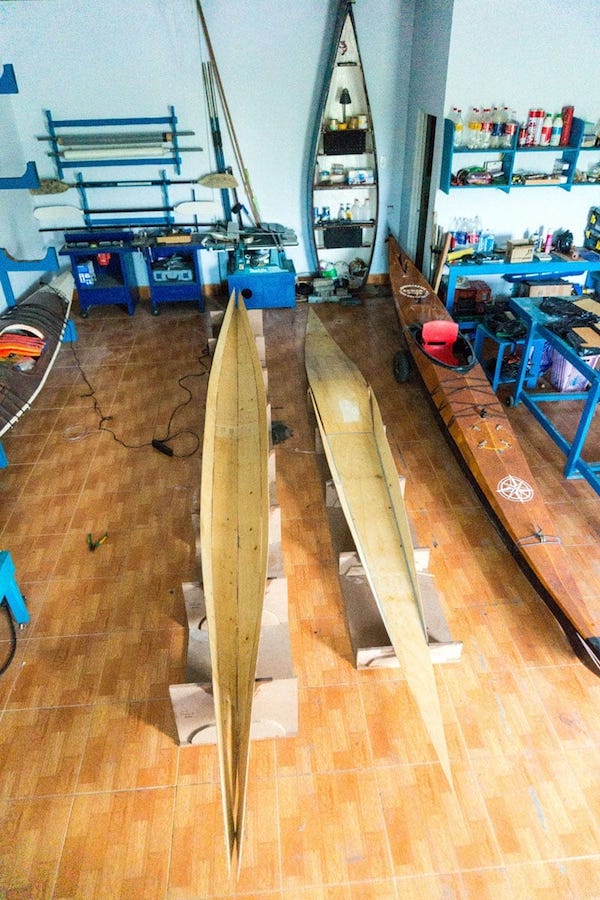
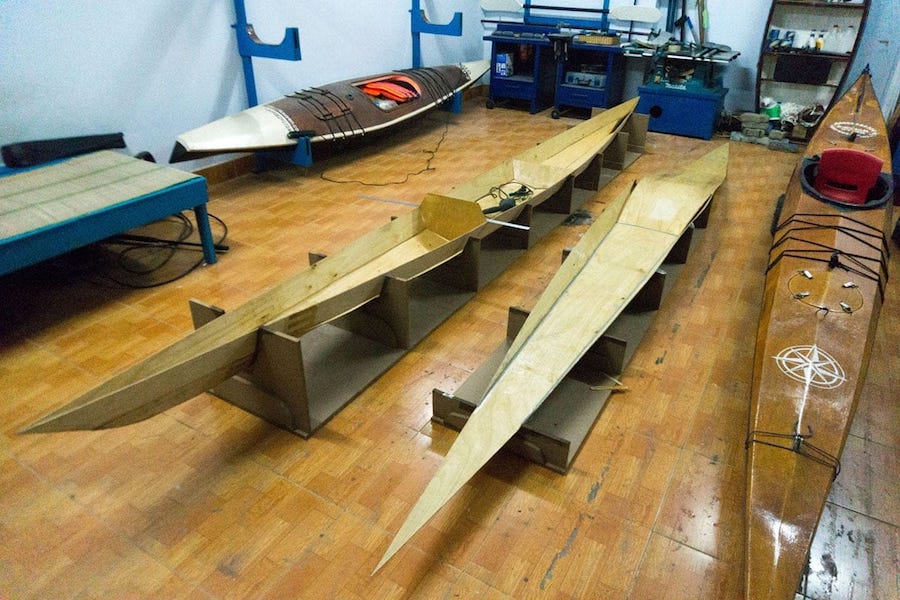
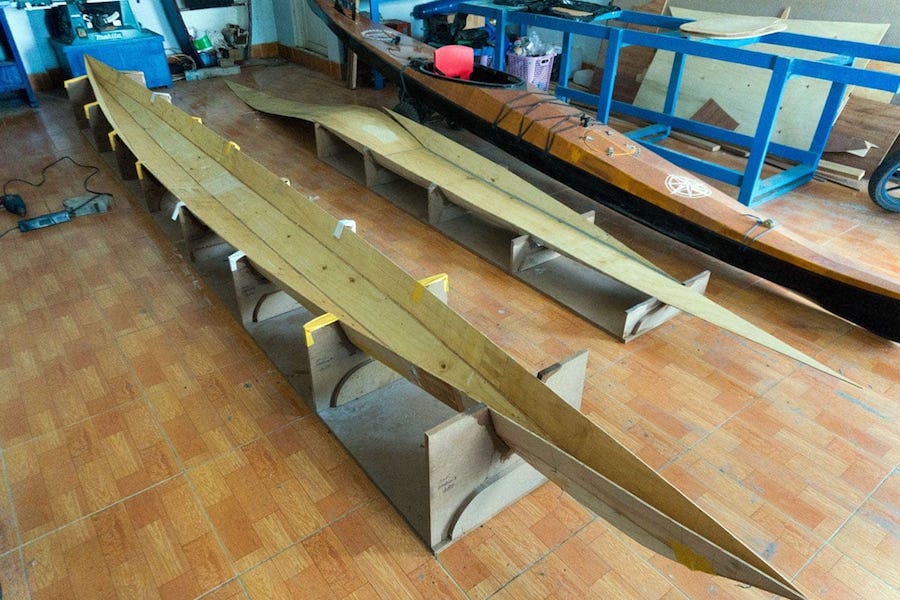
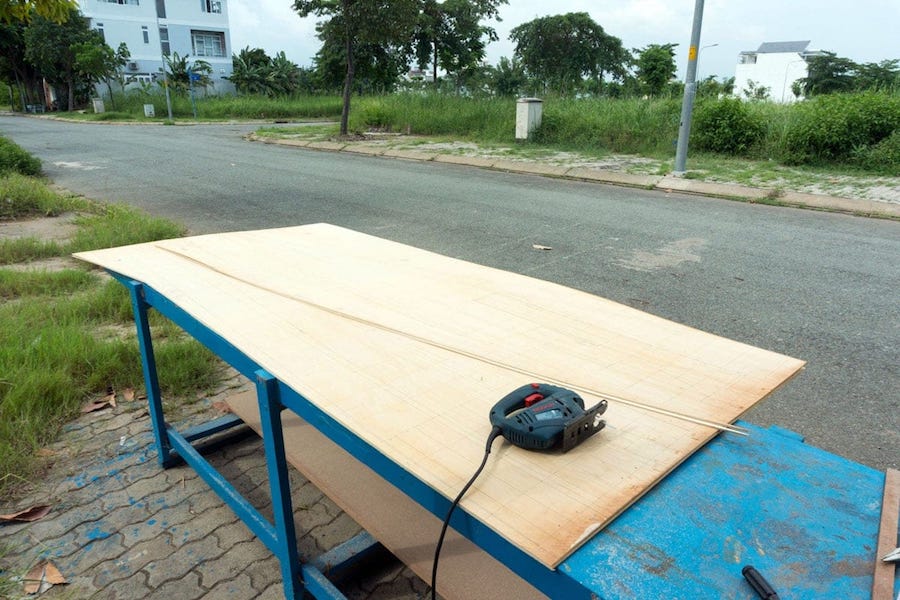
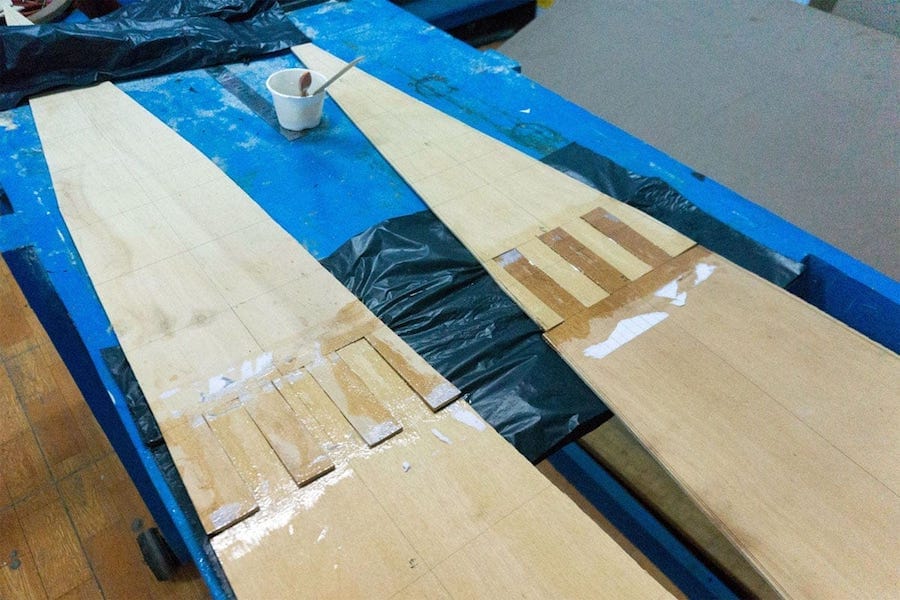
The bigles jointed very well, with just some neglectable tiny defects, port and starboard pairs match perfectly. Before putting them all together to form the initial boat shape, I applied a layer of penetrating epoxy (epoxy thinned with xylene), taking care so that the amount of epoxy used won’t exceed 0.6 kg overall. For this job, I use a kind of elastic epoxy with the B5 slow hardener. There’re two kinds of epoxy: one hard and one elastic, with at least 3, 4 kinds of hardener available in the local market.

I put a layer of fiberglass to the internal side of each joints before stitching the bilges. The deck is quite easy to form, since it’s very well geometrically – defined, I don’t even need to use steel wire and thus, avoid the unpleasant job of drilling holes, just duct tape over the edges, then dully apply the putty onto the bevelled seams. The hull is not that simple, with wires to fasten particularly at the two ends. Check the geometry of the overall shape, fasten the wires tight, then fill the seams with putty.

Cares are taken to use as little putty as possible, as I especially long for this to be a light boat. The same steps as in my previous boats, but done by more skillful hands. Actually, I sometimes feel bored with those same things having been been done 4 times already, I should be planning for another boat in a different building method. But sure, not until I could feel I’m good enough at the current method, if you’re not “up to the level” yet, you would probably done wrong with whatever method used.

Serene – 1 p1
Serene – 1 p2
Serene – 1 p3
Serene – 1 p4

I wouldn’t advocate the use of thinned (penetrating) epoxy here, using it or not depends on the specific situations. In general, it should be avoided as it would add much more weight to the final product. However, the plywood available to me is not of marine – grade quality.

It’s made of a kind of “tea tree” wood, though apparently has some tensile strength, is quite porous and indeed lacks compressive strength. To compensate, some penetrating epoxy would help the plywood to become more firm and prevent delaminating in the long run.

serene – 1, part 6

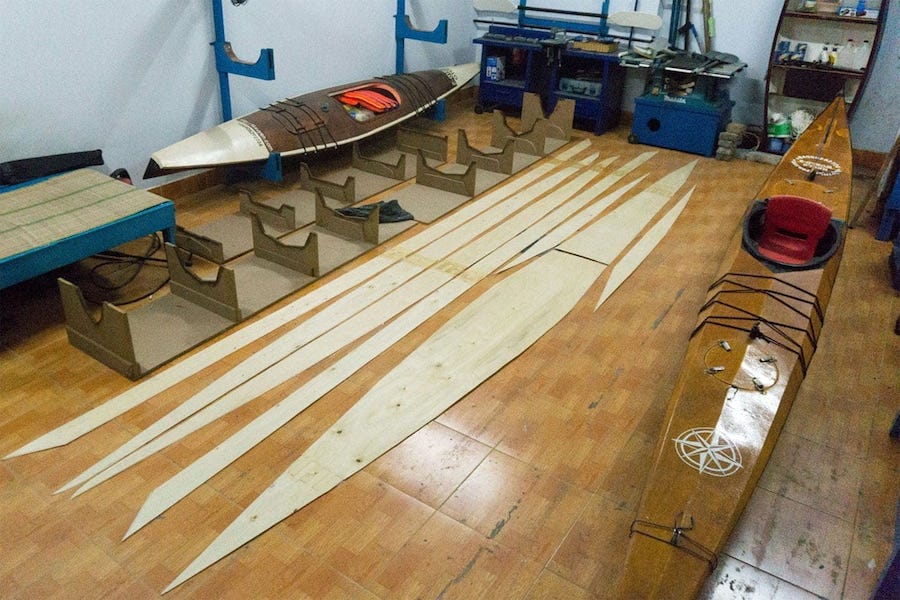
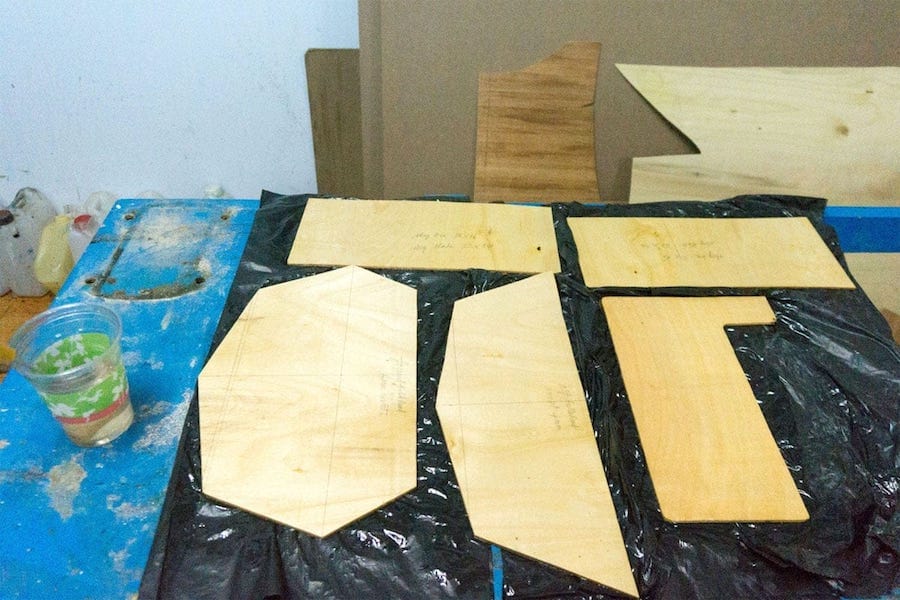
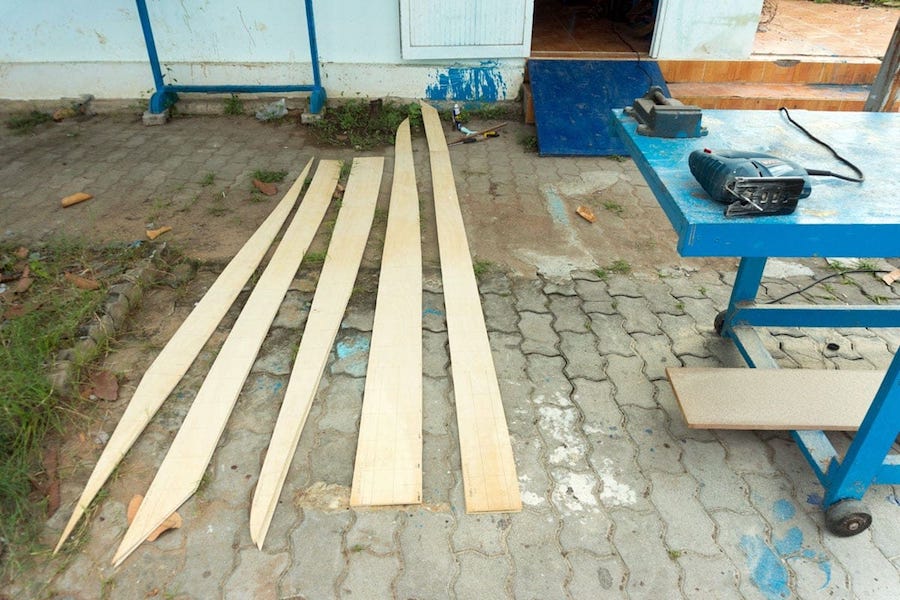
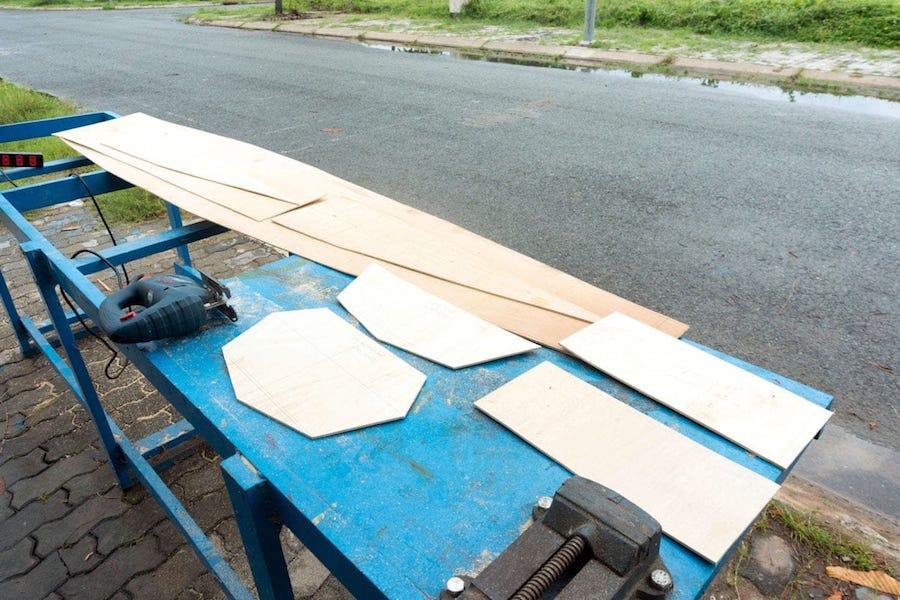
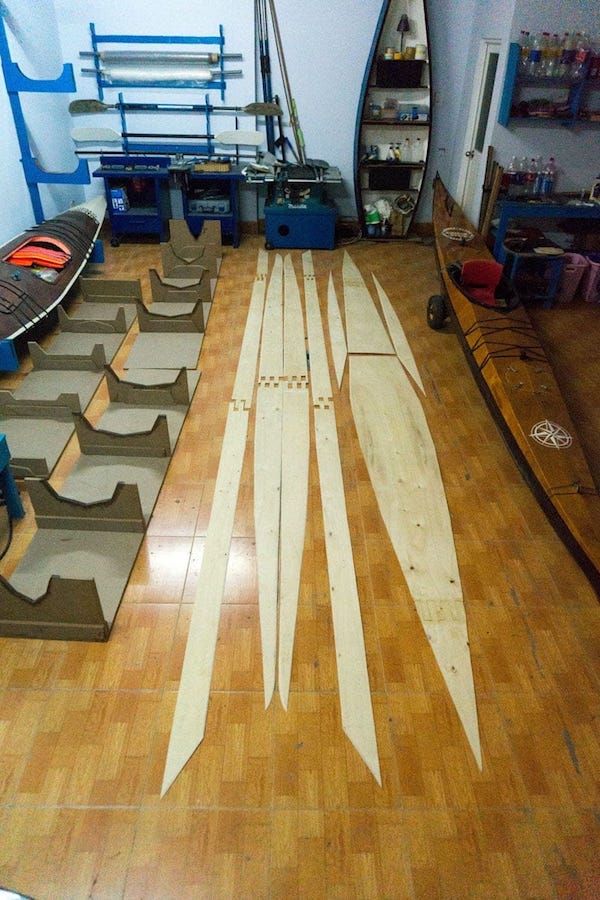
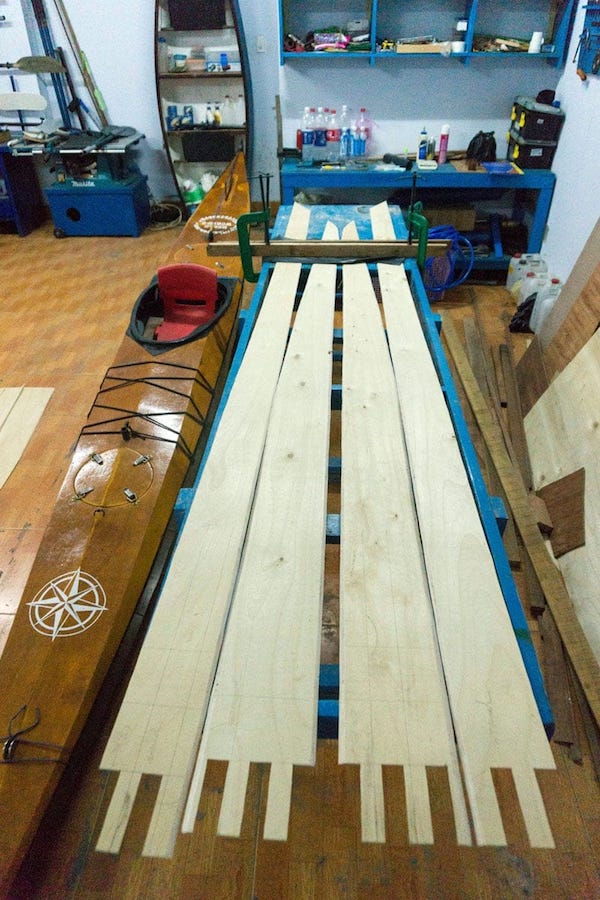
Using staples to clamp 2 sheets of plywood together, I then cut the hull’s planks, port and starboard, all is composed from 3 pieces. Then the deck’s pieces, and other parts: forward and aft bulkheads, skeg box and skeg blade… After 3 boats, I can now cut the wood with quite some accuracy. Sometimes, I’d wished to have the accuracy of a CNC machine, but such a machine that can cut in the 1.22 x 2.44 m dimension is not a possible option for most home builders, including me.

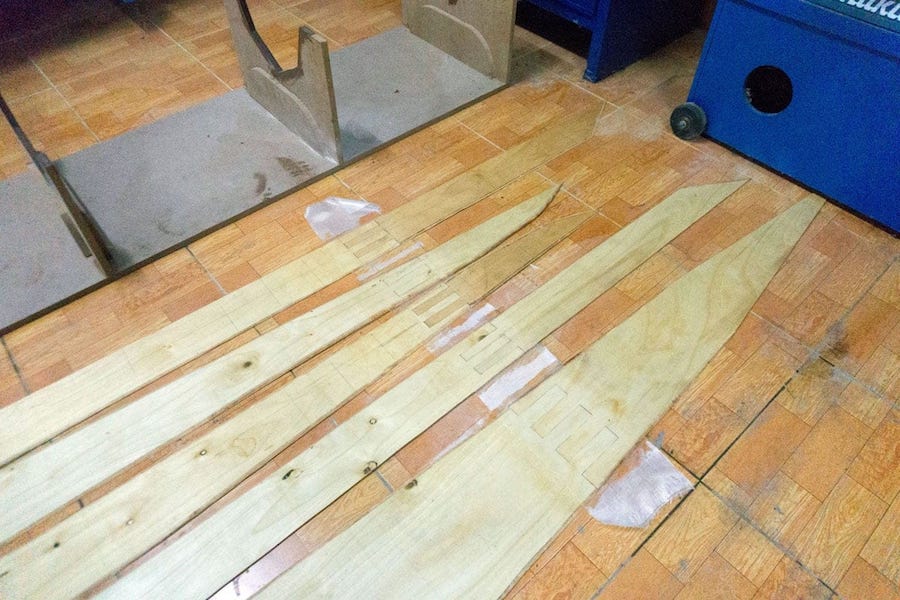
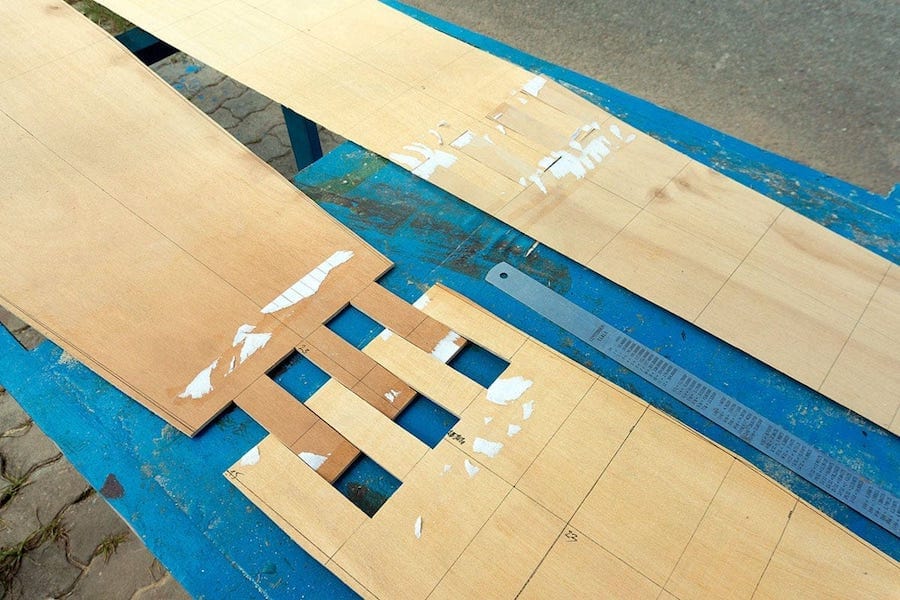
Next is the dusty job of beveling the edges of the plywood bilges, the edges are carefully bevelled at different angles along their lengths, to ensure a suitable gap, not too small, and not too big, for just a small amount of putty to go into the seams in a later phase. Then I joint the parts together using finger joints instead of the originally – planned puzzle joints. Straight finger joints, though not as strong as puzzle joints, they’re easier to cut and to fit, and most importantly, easier to align longitudinally.

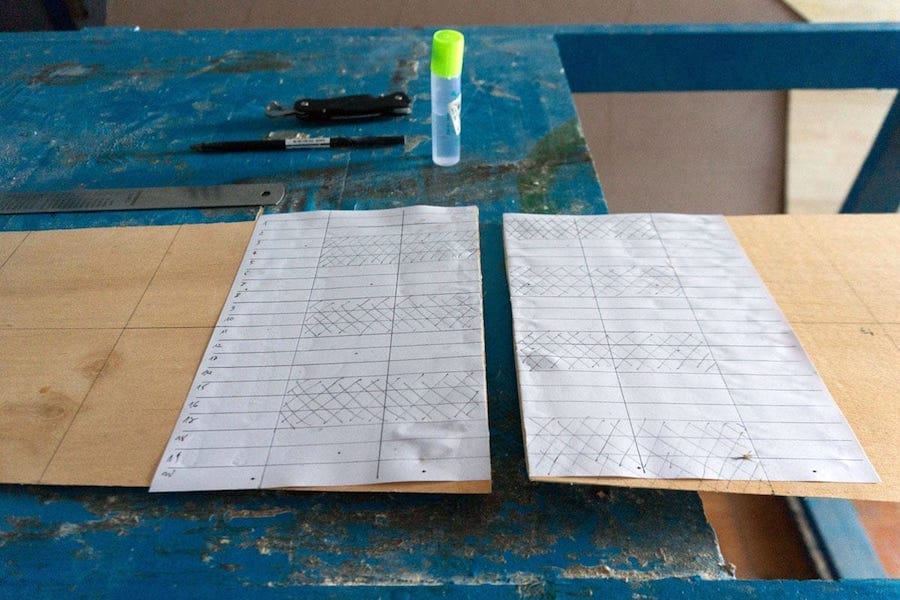
This is very important, in my first boat, the 2 ends of port and starboard bilges differ as large as 5 ~ 6 mm. I can now confidently keep the tolerance under 1 mm along the 5.5 m length. Patterns of the joints are drawn on paper, photocopied into multiple sheets, glued onto the plywood and cut accordingly. I work carefully as to ensure a tight fit, an accuracy of a small fraction of a millimeter is required. This is quite hard when done by hand as my thinnest saw blade is already over 1 mm thick.

Serene – 1 p1
Serene – 1 p2
Serene – 1 p3
Serene – 1 p4

The phase measure twice, cut once struck me once again. As I’m about to joint the bottom bilges, I discovered that 2 pieces were incorrectly drawn and hence were cut 10 cm shorter compared to the design. Frustrated, I stopped working for a day, feeling really miserable…

I found out a way to cut (puzzle) joint nicely: just draw & cut something on the 1st piece of wood, the pattern doesn’t need to be too perfect, then use it as a template to draw and cut on the 2nd piece. This method is less error – prone compared to cutting twice following one same pattern.

serene – 1, part 5

Serene – 1 is quite a distinctive boat, originally took inspiration from the Black Pearl and the Anas Acuta, but in it current status, it shares not a single common point with them. The hull has been transformed into a light cruising one with long water line, deeper V bottom, little rockers and a very narrow beam (45 cm). There’re times that I’m worrying on the feasibility of the design, except for some theoretical calculations, there’s nothing to ensure me that it would be a good watercraft.

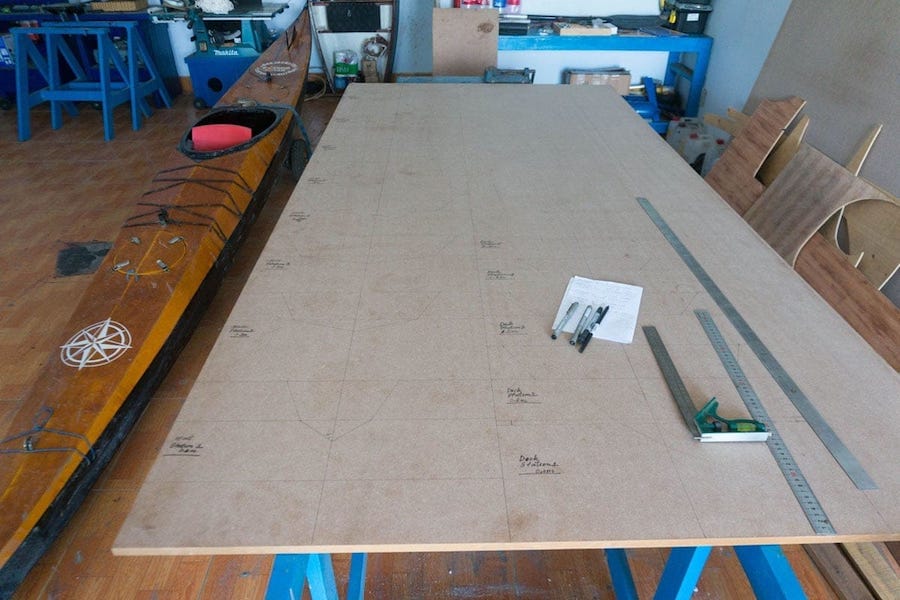
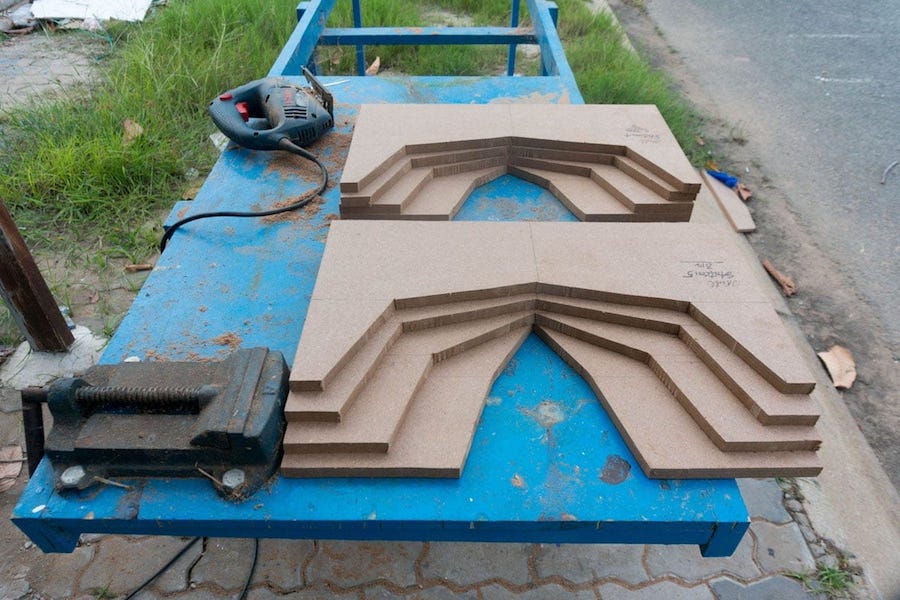
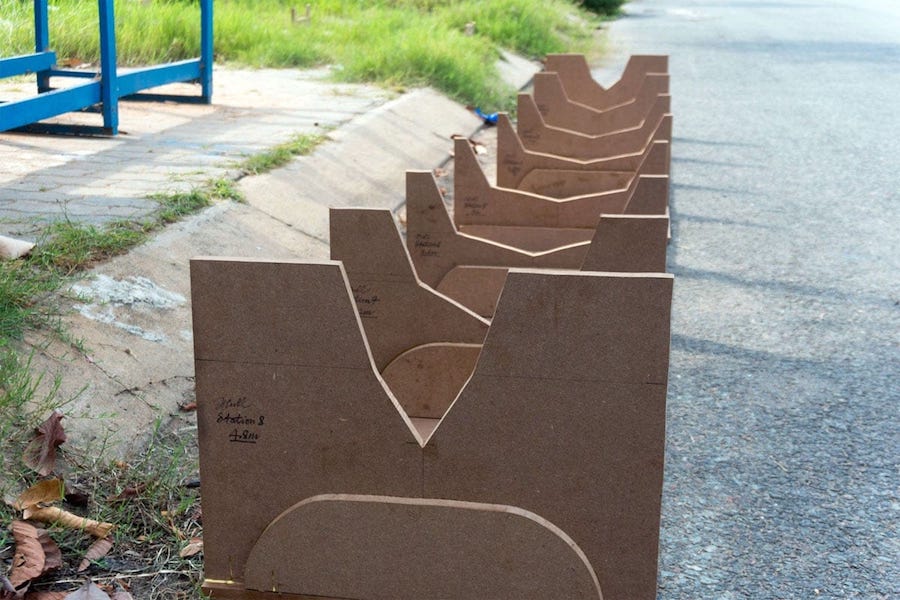
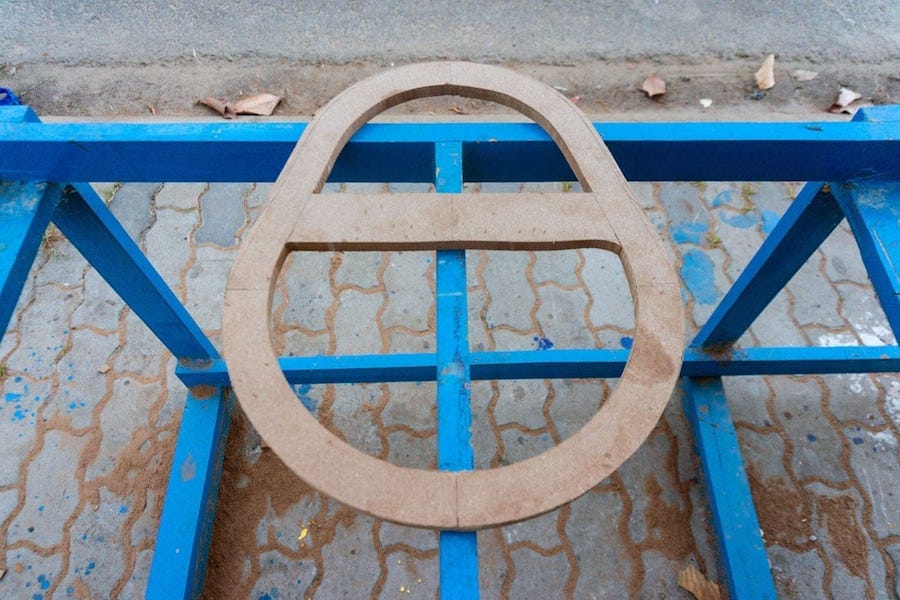
When you build something from a well – known designer, it’s already a well – proven boat. For Serene – 1, there’s no way to know, unless you build and trial it yourself. Eventually have some free time to proceed on today, first is cutting all the hull & deck framing stations in MDF. Can also see drawn is the cockpit template, this would be a very small one, 50×40 cm in dimensions, that’s what they called an “ocean cockpit”, you would need to climb over the aft deck and slide your legs into the hole.

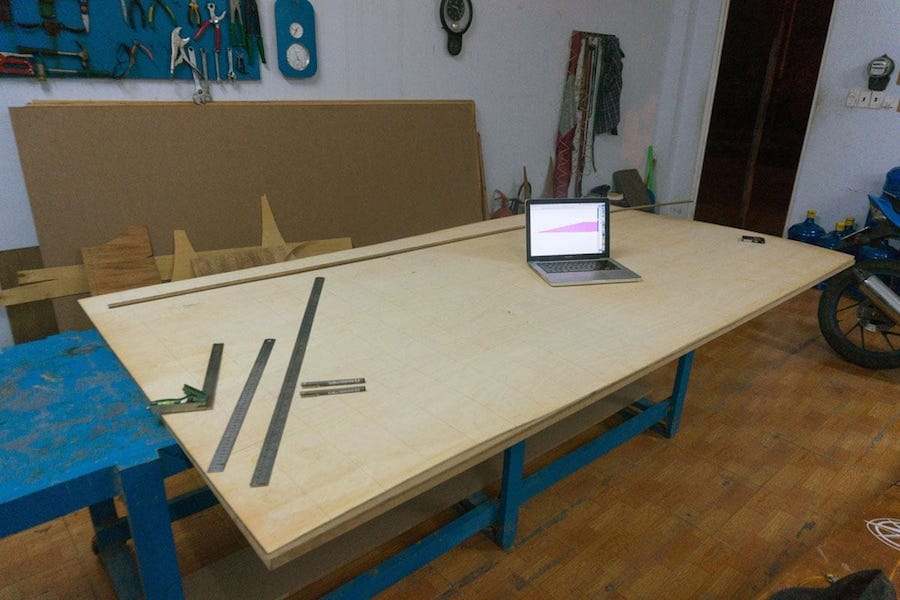
The framing box showed up, by now, I could see how slim the boat would be, at this size, you just don’t ride the kayak, you essentially… wear it! Like an integral part of your body going to rough water, that’s how the feeling should be! Next would be the important task of drawing, and cutting the bilges from exported offset tables. For ones who don’t know, offset table is just a matrix of (x, y) coordinates, I use a very fine matrix (points every 5 cm interval) to precisely reconstruct the bilges on plywood.

Serene – 1 p1
Serene – 1 p2
Serene – 1 p3
Serene – 1 p4

One important note about various hull shapes (V – bottom, round, flat, etc…), cross section only affect stabilities, they have little effect on the boat’s speed which depends mostly on the waterline length and the wetted surface area. I tend to prefer hard chined V – bottom though.

About Prismatic Coefficient (Cp): a lower value indicates that the boat is more efficient at slower speed, a higher one tells that the boat is more efficient the faster it goes. So higher or lower Cp is neither good nor bad, it’s just that you need to know where is your desired range of velocity.

serene – 1, part 4

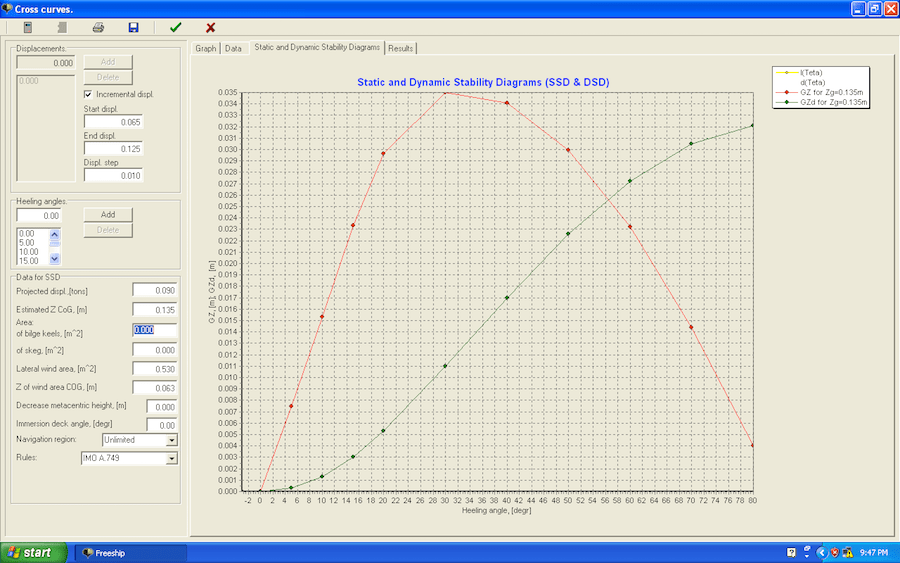
Finalized my new kayak design, a considerable amount of work on optimizing the hull shape, adjusting it back and forth to find out the minimum drag numbers (based on the Kaper algorithm) while keeping stabilities and other parameters under control. Some numbers: LOA / LWL (length overall / waterline): 5.500 / 4.945 m, BOA / BWL (beam overall / waterline): 0.452 / 0.420 m. I reduced the boat width to exactly my hip plus 4 fingers (that is: 36 + 9 cm, my fingers are quite big, 9 cm for 4 fingers).

Designed draft: 0.11 m, Designed displacement: 95 kg, Cp (prismatic coefficient): 0.5475, Cb (block coefficient): 0.4064, LCB (longitudinal center of buoyancy): 0.5225, VCB (vertical center of buoyancy): 0.0690 m, LCF (longitudinal center of floatation): 0.5136, Cw (waterplane coefficient): 0.6445, S (wetted surface area): 1.699 m2, Aw (waterplane area): 1.329 m2, Am (midship section area): 0.034 m2, Cm (midship coefficient): 0.7466, KMt (vertical transverse metacenter): 0.196 m.

Predicted drags at 0.11 m draft (95 kg of displacement): 3 knot ~ 7.122 N, 4 knot ~ 12.622 N, 5 knot ~ 23.763 N. Predicted drags at 0.121 m draft (110 kg of displacement): 3 knot ~ 7.679 N, 4 knot ~ 13.611 N, 5 knot ~ 25.506 N. The hull is heavily optimized for speed in the [4 ~ 5] knot range with some sacrifices in stability and load capacity. Now that all “theoretical calculations” has completed, it would take a few months to build the physical boat to tell the real truths about the design!

Serene – 1 p1
Serene – 1 p2
Serene – 1 p3
Serene – 1 p4

While 45 cm could be considered “extreme” for nowadays kayak (few available on the market has width at or below that value), it’s not really so with the traditional Greenland ones, some could be as narrow as 39 cm. Well for sure, it requires lots of skills to handle such a narrow boat.

The very important point here is the CG (Center of Gravity) used in calculating stability. The Sea Kayaker magazine uses a standard 25.4 cm as CG, as a reference point to compare different kayaks. I used the midpoint of VCB and KMt as CG, which is usually [12 ~ 14] cm for my cases.

serene – 1, part 3

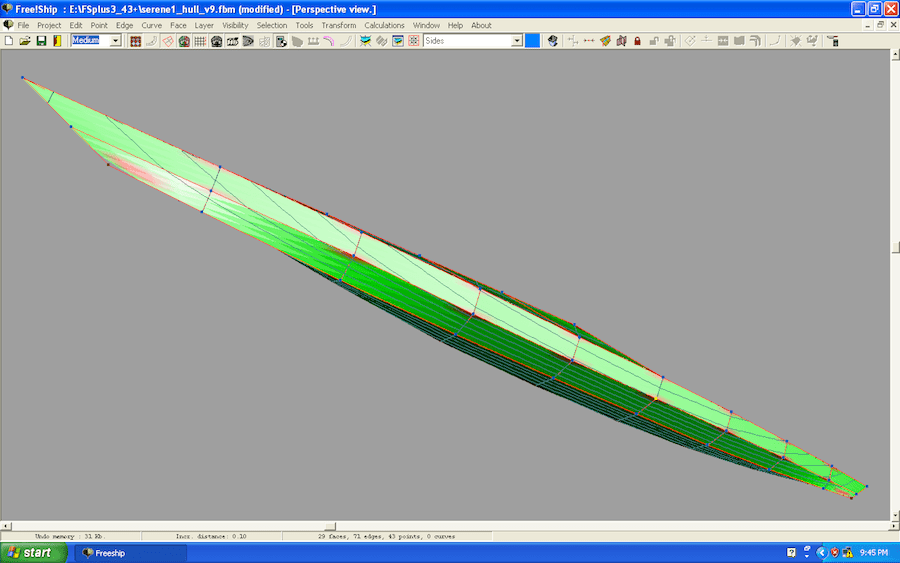
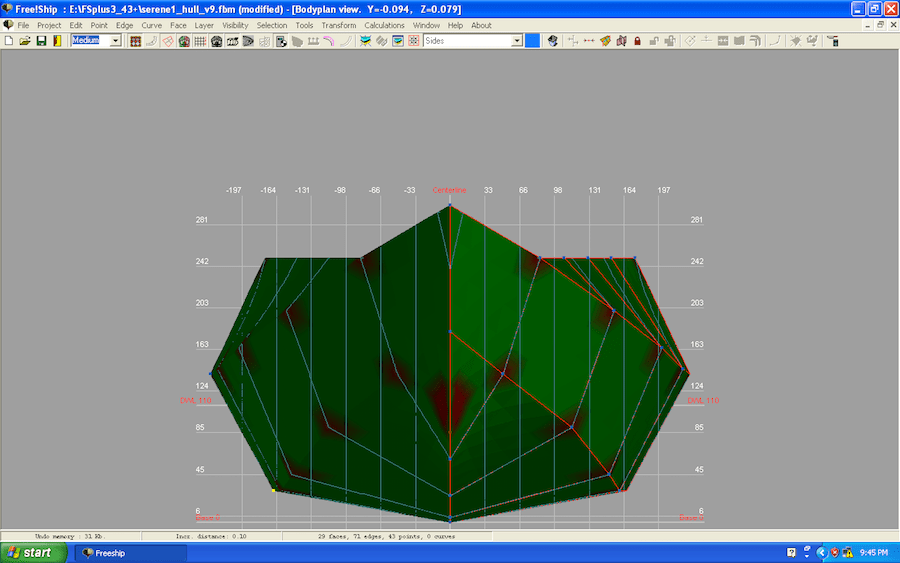
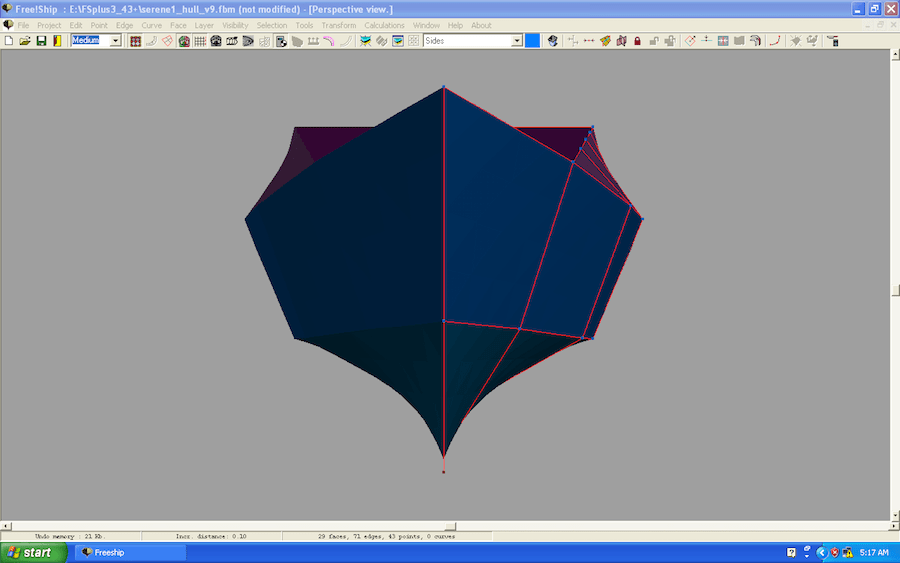
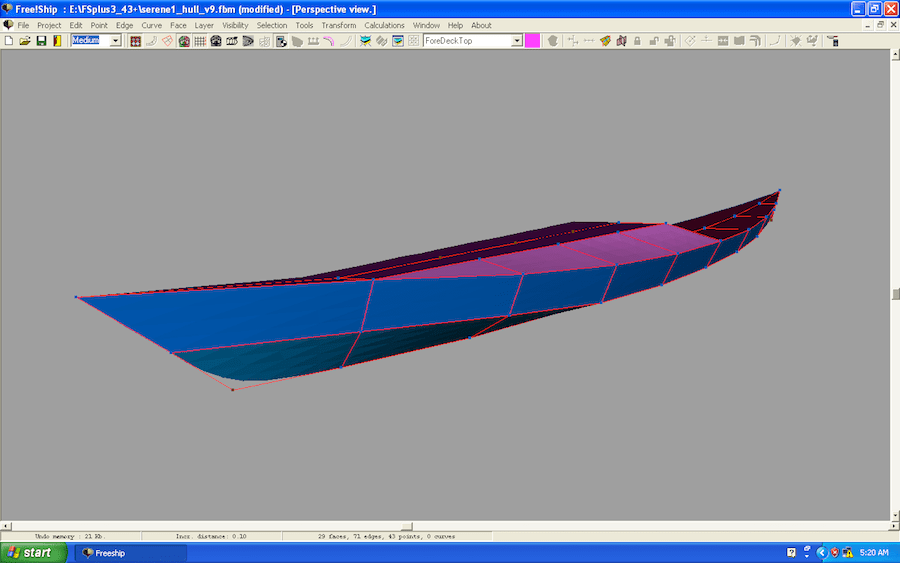
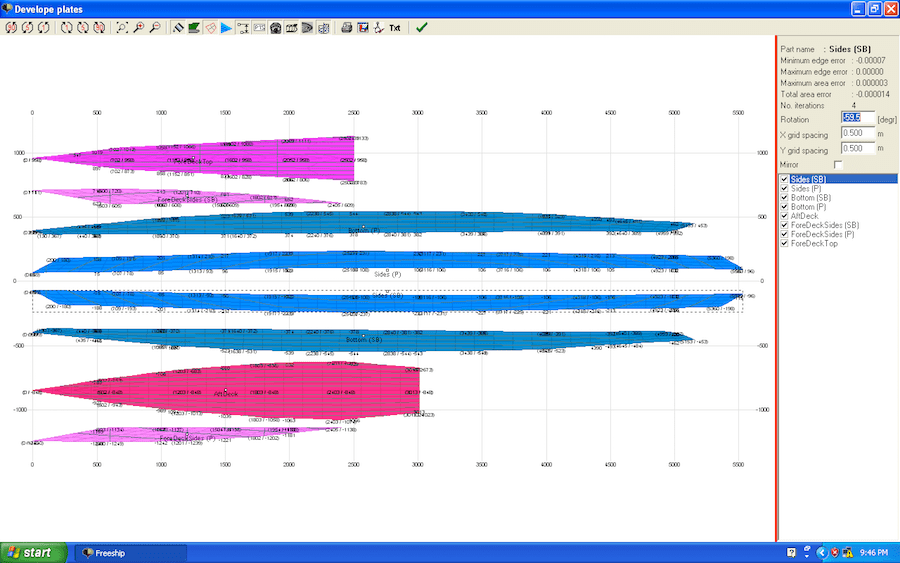
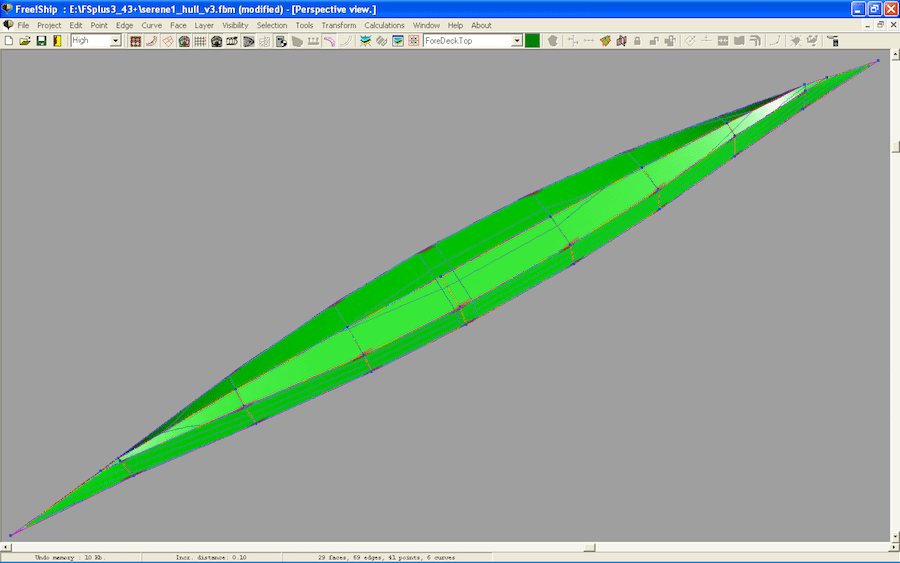
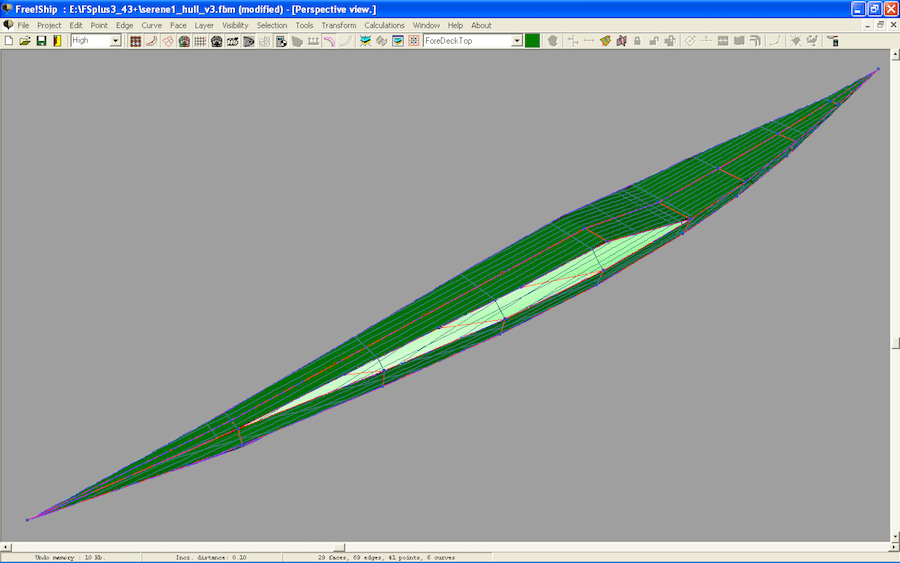
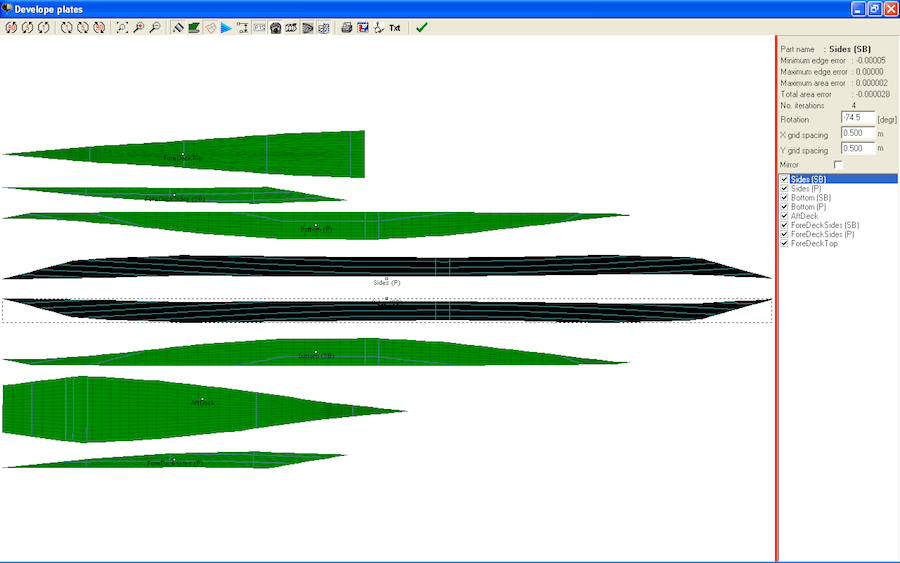
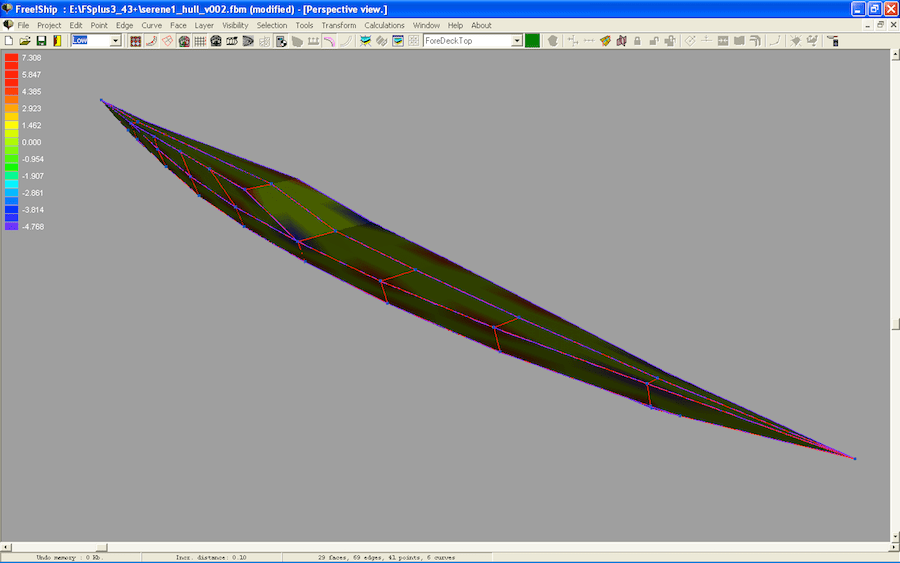
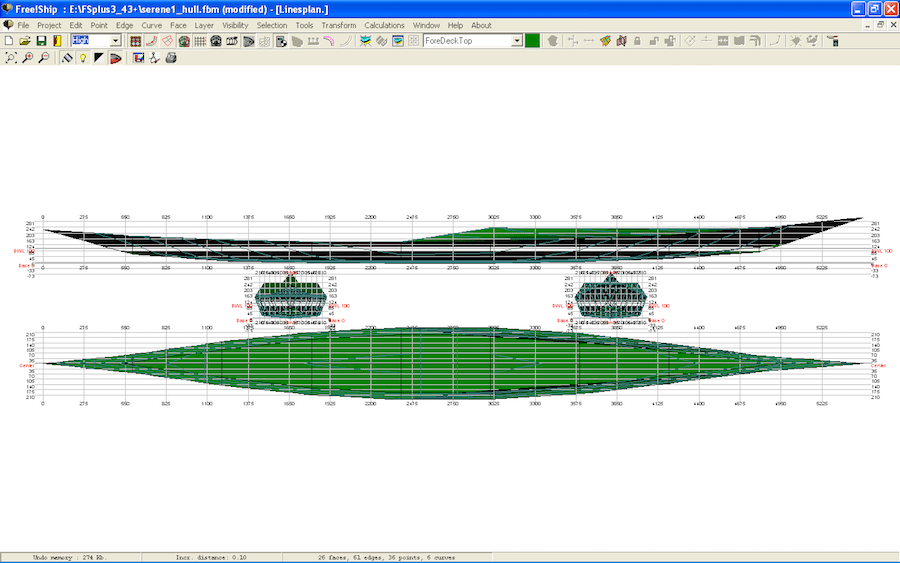
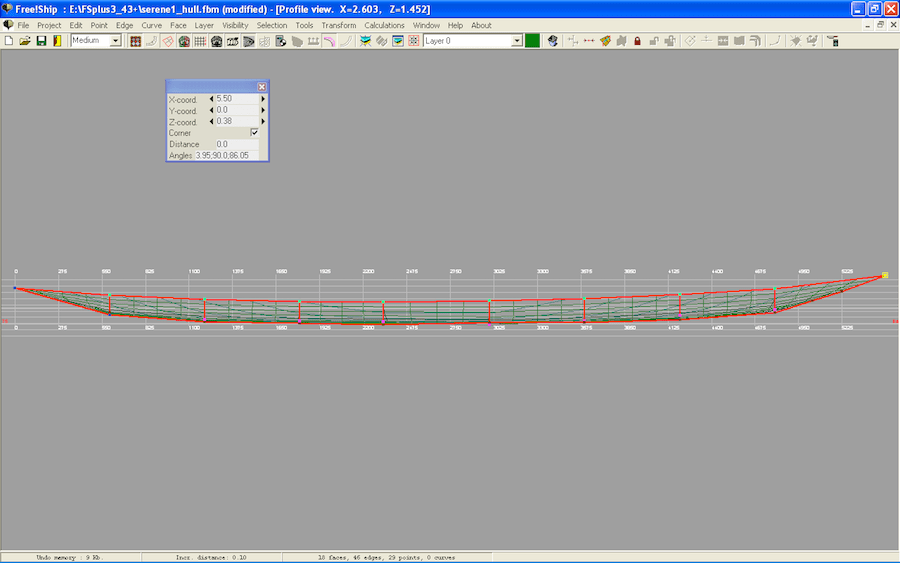
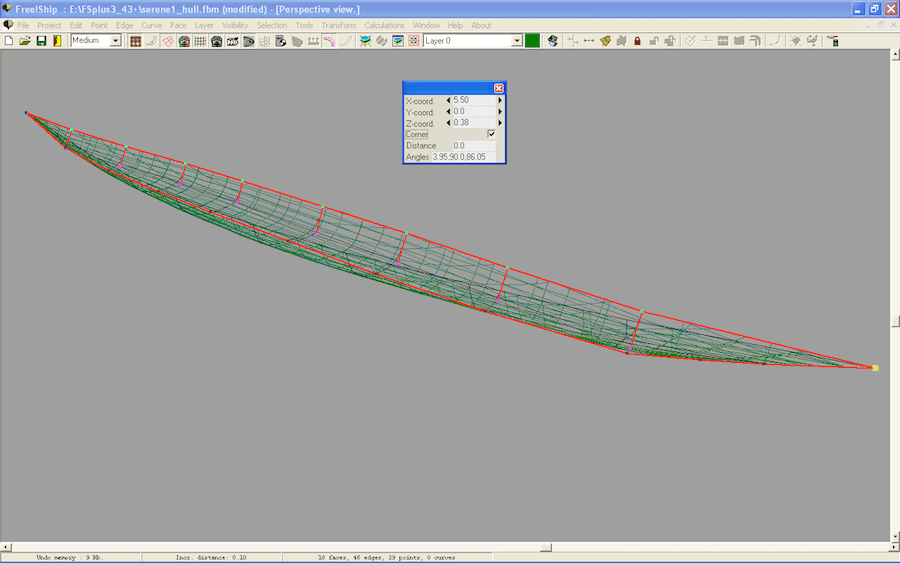
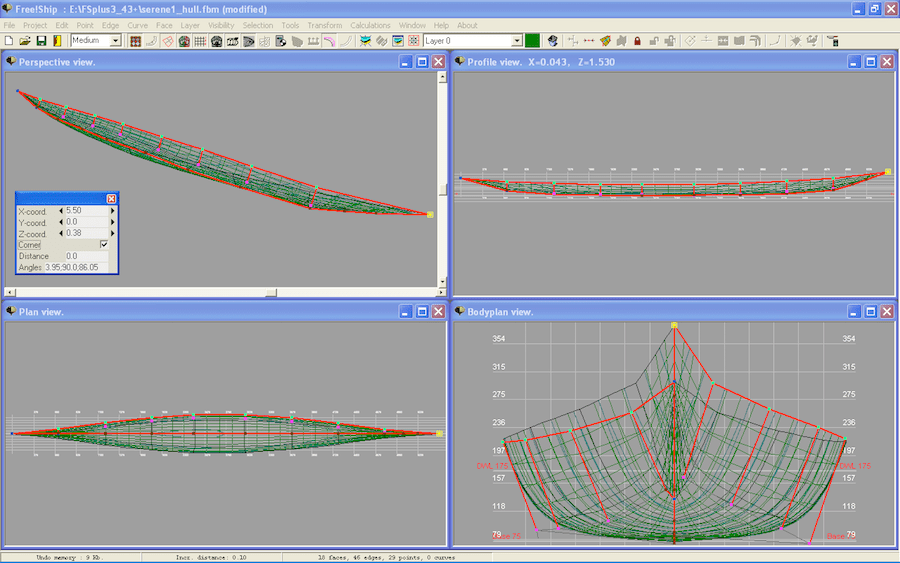
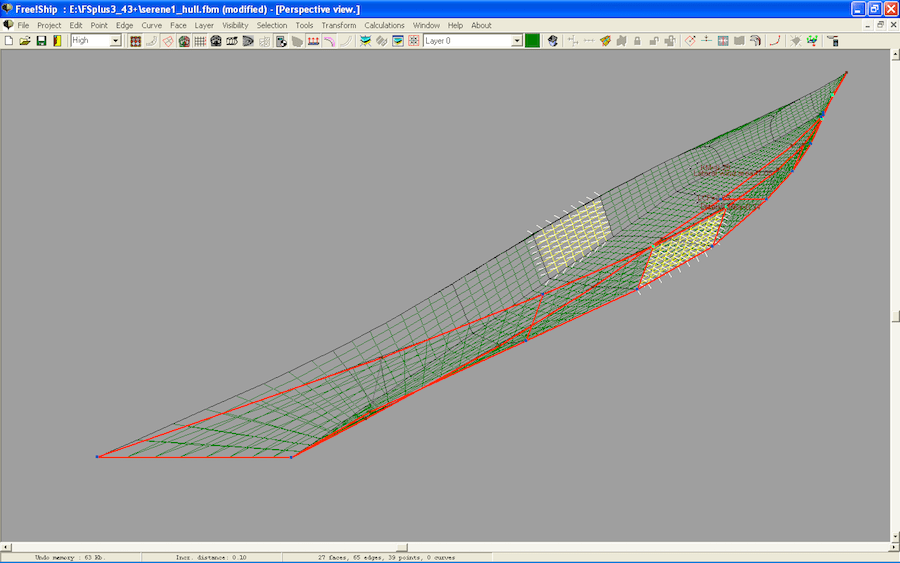
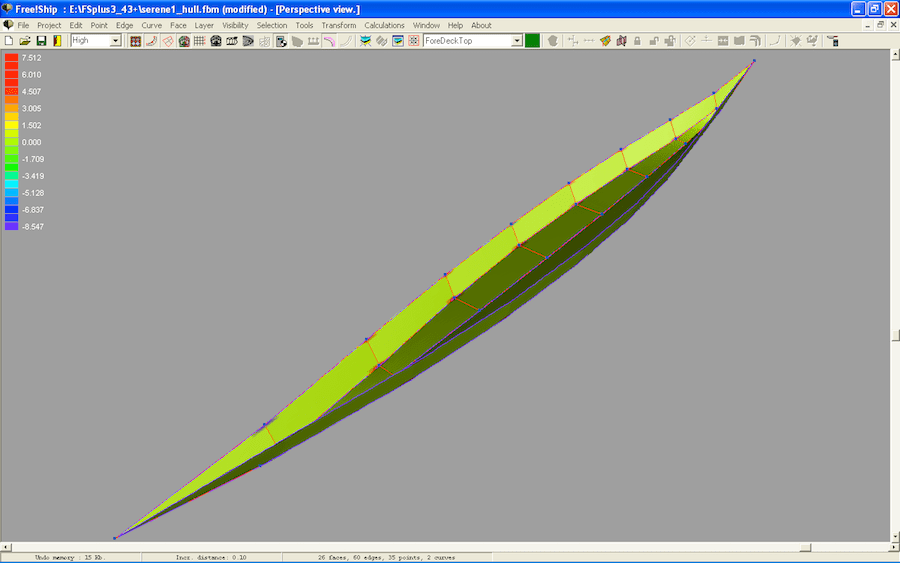
Made some good progress in the process of modeling my new kayak… For a human – powered watercraft, water doesn’t like complex curves and shapes I think, so they need to be as simple as possible (it is not too simple to come to that simplicity though). The model is then decomposed by Free!Ship into several “developable” plates, at this point, professional builders could just output the plates to a large CNC machine, which would precisely cut the plywood accordingly.

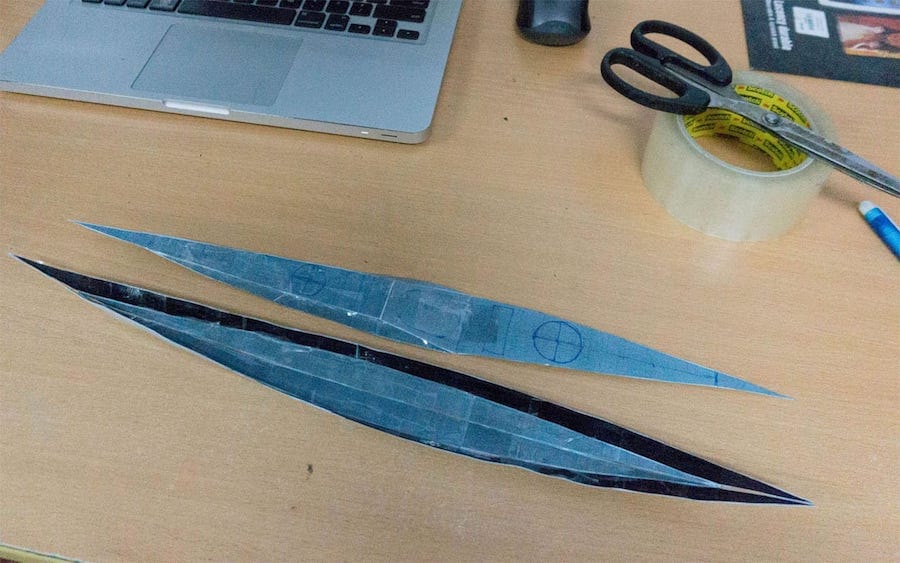
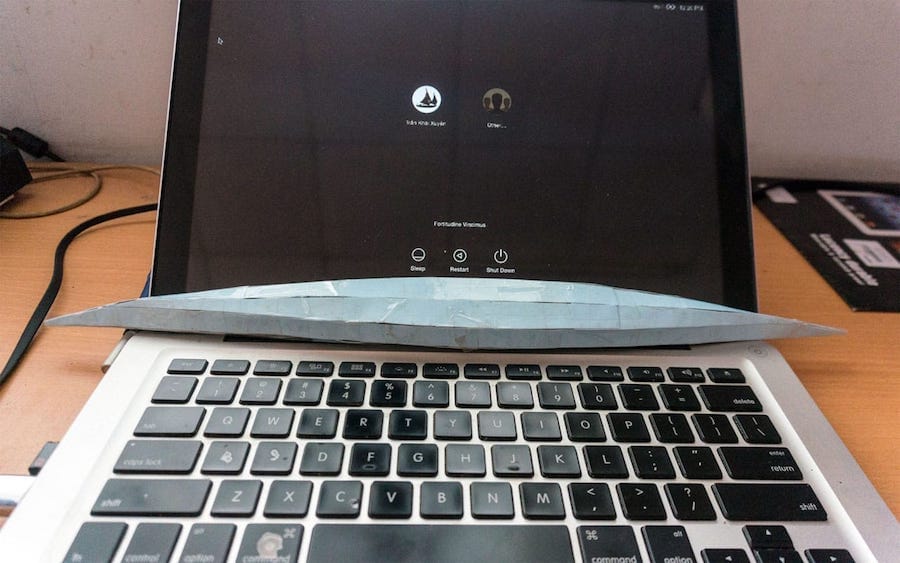
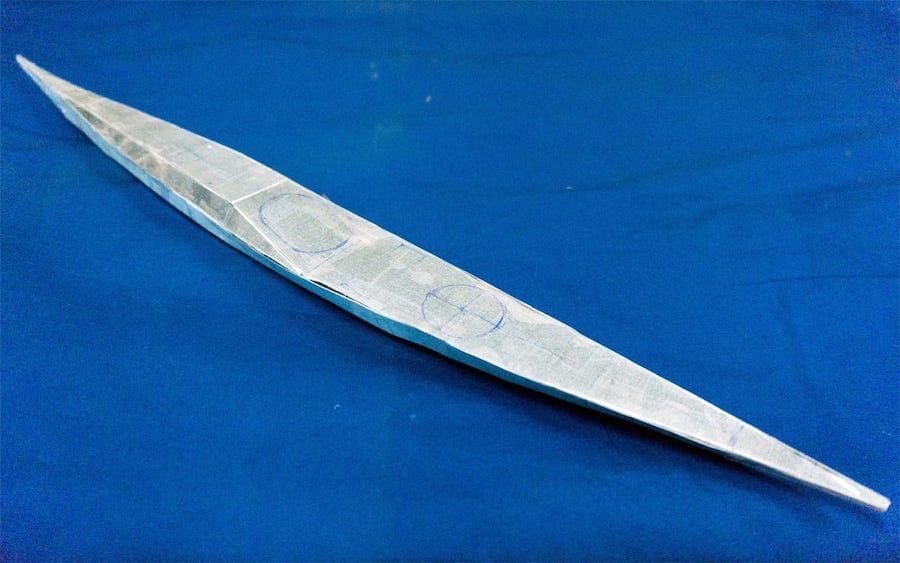
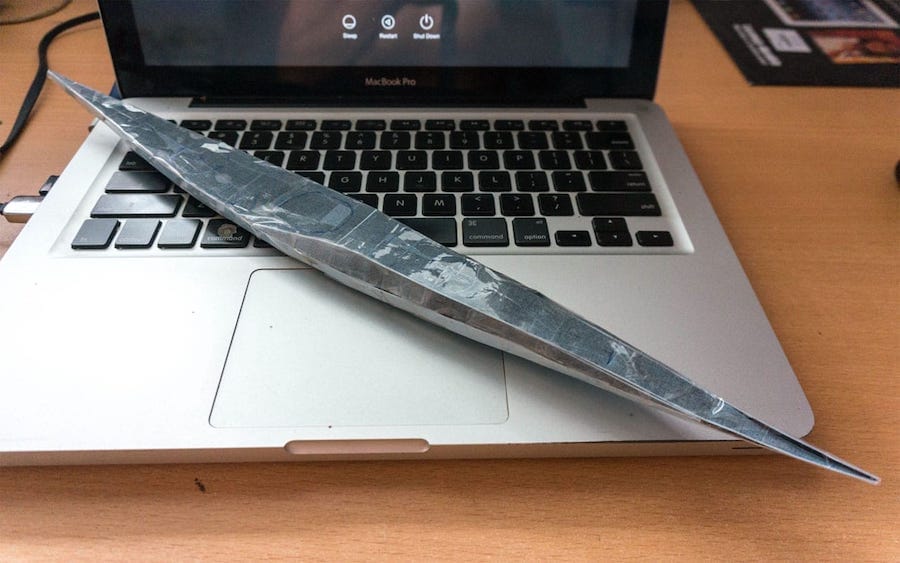
I print those plates to paper to make a 1:15 paper model. Cut the plates with a pair of scissors, then stitch them together using transparent duct tape. Making a paper scaled model would help verifying about the “develop – ability” of the product, double check if there is any design mistake, and give a clear view on how we should compose the pieces into the final boat. For simplicity, I didn’t draw details such as the cockpit, skeg, lines or hatches, just the basic shape of the kayak.

The paper model is a bit ugly (my hands are not too skillful though), but the pieces come together perfectly, the shape just looks like a bamboo leaf! This gonna be a long, thin kayak with very little freeboard! Next would be finding some free time to materialize all these drawing onto the plywood sheets. I don’t have a printer that’s large enough to print the plates in their real sizes, so I would just redraw them using offset table exported from the CAD software, actually, I prefer this manual method!

Serene – 1 p1
Serene – 1 p2
Serene – 1 p3
Serene – 1 p4

Back to the number 70.39 Watt, a heavy labour (such as a bricklayer) produces about 75 Watt on average, and for only 8 hours. You know what it’s like to paddle 10, 12 hours on a minimum basic, or even more, like I was paddling for 16 hours from Vũng Tàu back to Sài Gòn in my last trip!

The book Kayaks Of Greenland by Harvey Golden is a great guide for home builders, it contains dozens of kayak models ready to be built, with all the necessary drawings! I used some models from the book as references and comparisons when designing this Serene – 1 kayak!

serene – 1, part 2

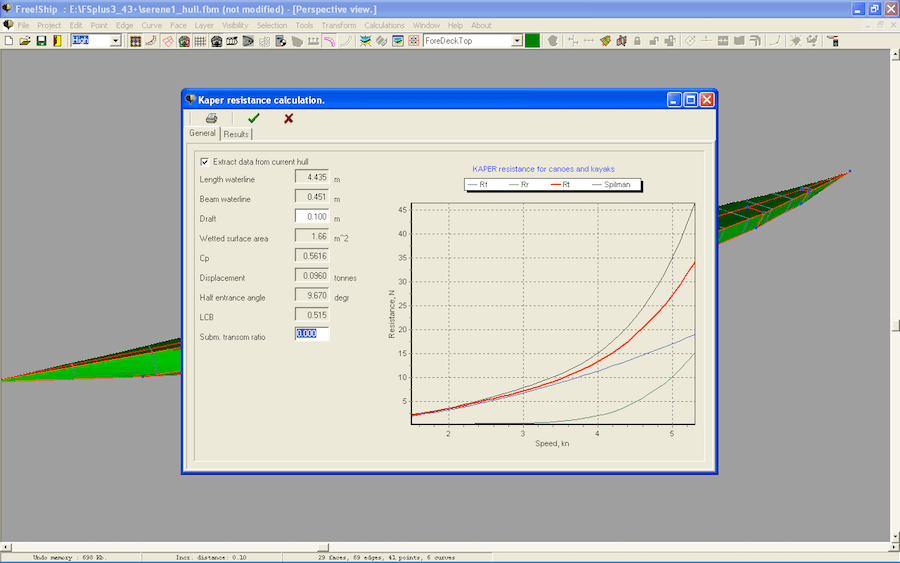
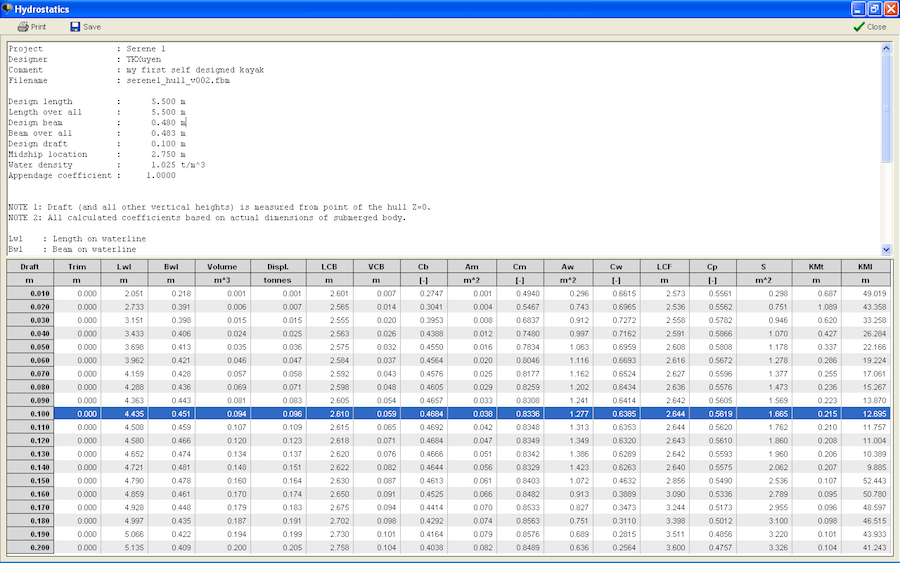
It tooks just a few hours to learn the new software and construct the basic 3D objects: hull & deck. The time – consuming tasks are adjusting the shapes and playing around with hydrostatics. Some basic measures: LOA / LWL (length overall / waterline): 5.50 / 4.44 m, BOA / BWL (beam overall / waterline): 0.483 / 0.451 m, Draft: 0.1 m, S (wetted surface area): 1.66 m2, Cp (prismatic coefficient): 0.5619, LCB (longitudinal center of buoyancy): 0.5150, LCF (longitudinal center of floatation): 0.5192.

Additional hydrostatics parameters, VCB (vertical center of buoyancy): 0.0590 m, Cb (block coefficient): 0.4684, Cm (midship coefficient): 0.8336, Cw (water plane coefficient): 0.6385, Displacement: 0.096 tonne… Well, I wouldn’t pretend that I fully understand those parameters above, cause they contain insights into a boat that can only be correctly interpreted by an experienced designer. However, I’m tweaking around to optimize the parameters toward a higher Cp, higher LWL, and lower S.

Drag (resistance) predicted by the KAPER algorithm looks fine till now, however, the displacement is sacrificed already, 96 kg, barely enough for me (65 kg) plus 30 kg of gears. This gonna be a demanding boat with low primary stability, not recommended for beginner. It takes some real world experiences to understand why low initial stability is indeed a good thing, and why a kayak which appears to be very stable on flat water could probably throw you up side down in bumpy conditions.

Serene – 1 p1
Serene – 1 p2
Serene – 1 p3
Serene – 1 p4

Some rough calculations on the energy required to propel a kayak. My target speed is 7 kmph, or 3.8 knots. From the numbers recorded by my Garmin over the years, in normal big rivers and sea conditions, speed is reduced by 1/3 compared to the ideal condition of flat water.

That is you have to struggle at 5 knots to assure that 3.8 knots. The Kaper algorithm tells you that, this Serene – 1 hull produces a resistance force of 27.35 Newton at 5 knots (or 2.57 meters per second). Making the multiply: 2.57 x 27.35, that’s the output required: 70.39 Watt!

serene – 1, part 1

In the progress of learning to design my new kayak… you know its name already. I’m using Free!Ship, a CAD software running on Win XP virtual machine (with VirtualBox) on my Macbook. I haven’t used any CAD software before, haven’t designed anything 3D, not to say about a watercraft. So why designing a kayak!? Well, first, just for the fun of doing something yourself from A to Z. Second, though I’m no naval designer in any sense, I believe I have some guts on how a good kayak should be!

Many kayaks are designed for 70 ~ 90 kg paddlers on average, I’m not that bold, and I need something slimmer, lighter, with the drawback of sacrificing some load capacity of course. I’m re – modeling my kayak after Björn Thomasson’s Black Pearl, using just some publicly – available pictures of the boat. And it’s not a copy, there’re some modifications: slightly narrower beam, slightly less rocker, and slightly deeper V – bottom. And I would stick still to my familiar stitch & glue construction method.

Why stitch & glue!? Strip build generally offers best boat shapes, but look at the Inuit people’s SOF (skin on frame) kayaks, those “hard chines” suit naturally to S&G, the method is simpler and takes less time (which I don’t really have much for now). It gonna be not an easy process: just for the hull, adjust the 60 control points back and forth, recalculate the stability and performance parameters, repeat again and again until you’re satisfied with the results. I hope I can finish the design in about a month or so.

Serene – 1 p1
Serene – 1 p2
Serene – 1 p3
Serene – 1 p4

Recently, I’d noticed that Japanese kayakers usually use kinds of slim, long kayak similar to the Black Pearl, that’s quite understandable cause the body – building of Japanese is Vietnamese alike, we’re not too bold. Use a slimmer, lighter boat, and pack your gears cleverly for longer trip!

It’s interesting to know that, in the old day, in building kayaks, the Inuit people has “recipes” to measure the size of the boat: length should be 3 times the height of the paddler, width should be the hip plus somewhere from 4 to 8 “finger”. Well, like shoes, boat is tailored to match the user.

workshop, 2

Như dòng sông ra đại dương, qua bao ghềnh và đá cheo leo.
Đấu tranh này bền lòng em ơi, mới tới ngày nắng ấm…

Lời người ra đi - Trần Hoàn - Khí nhạc: Nguyễn Đình Nghĩa 

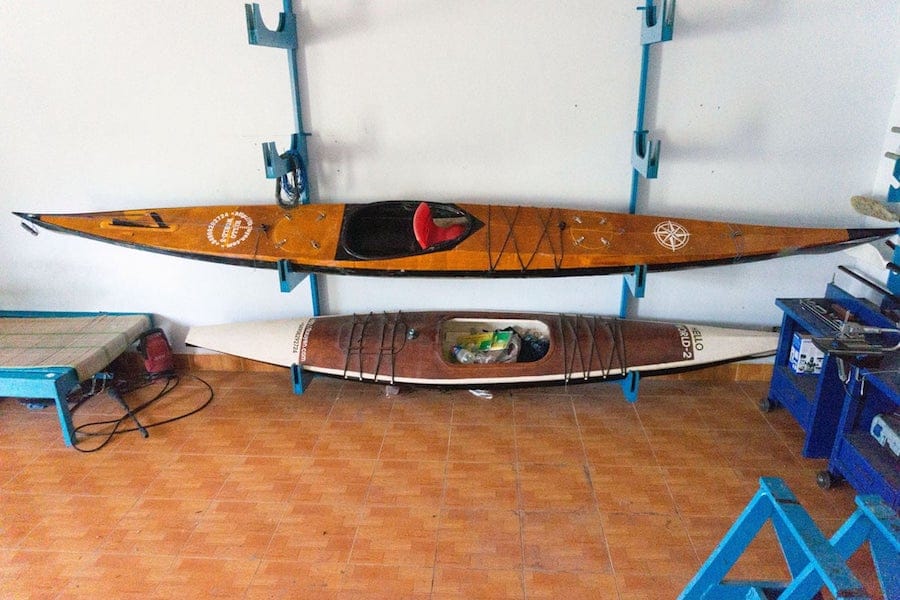
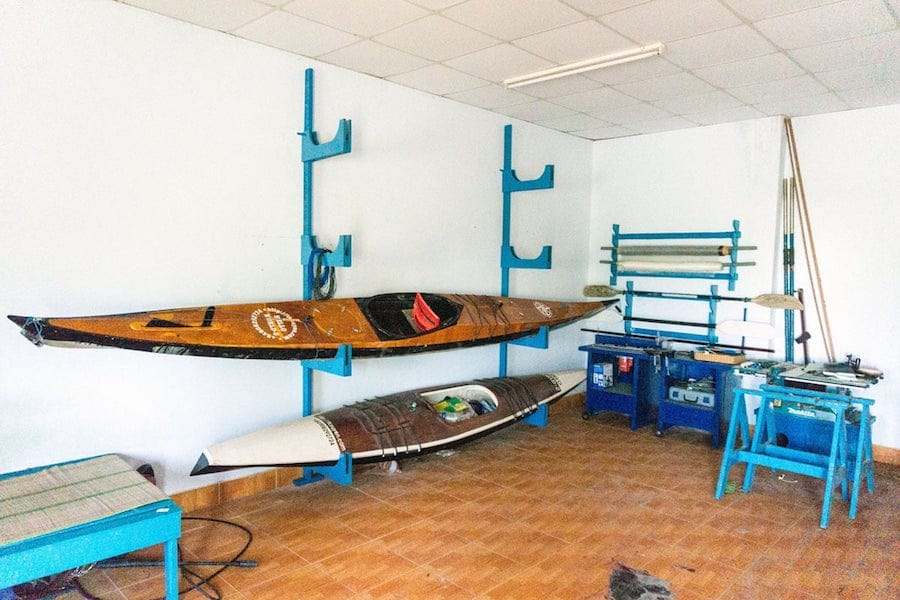
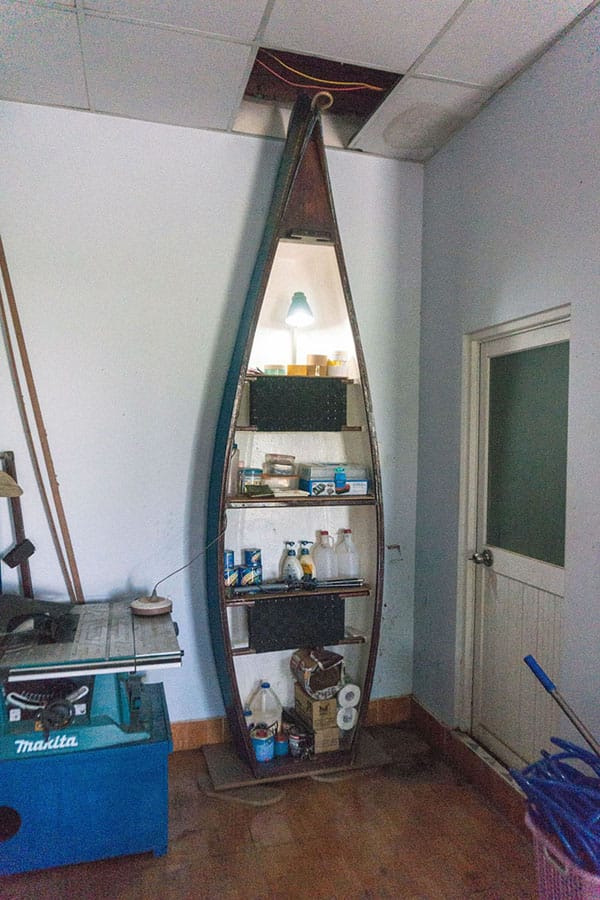
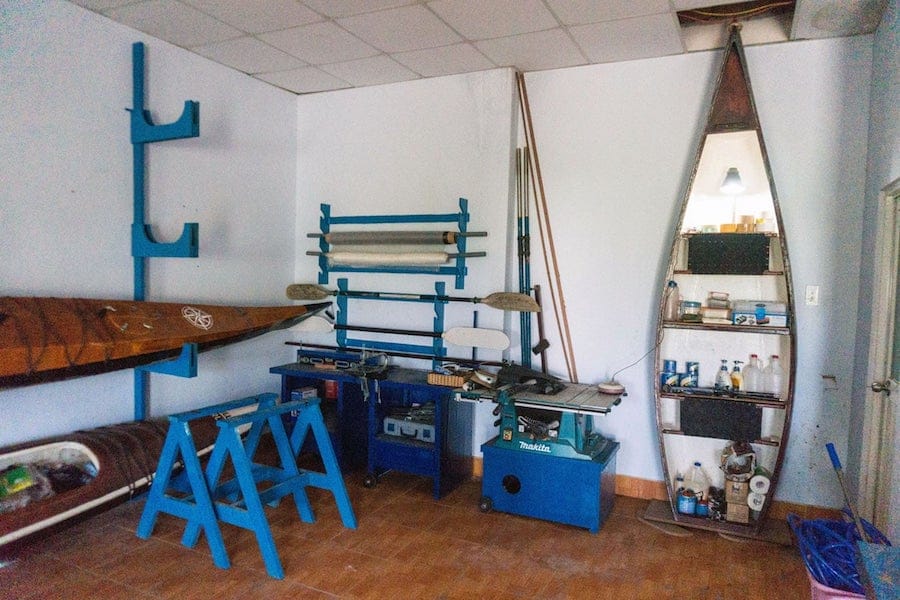
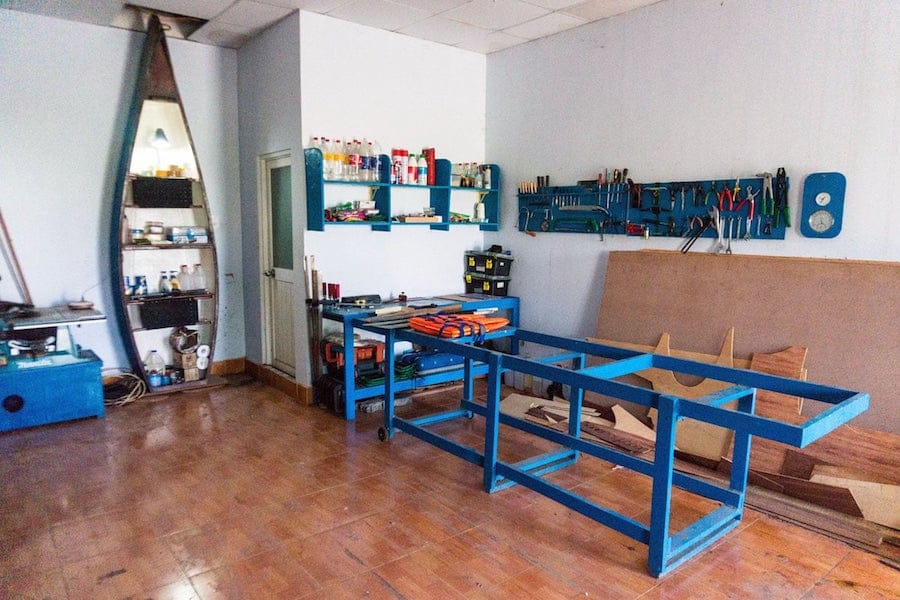
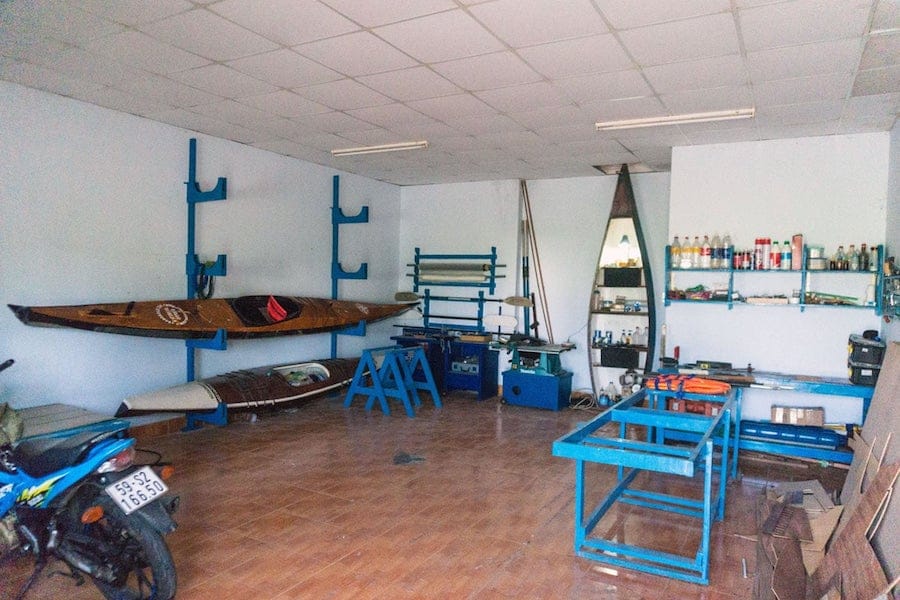
Take my little free time to do some updates for the workshop, it’s covered with layers of dust after months without any woodworking projects. First is the wall – mounted kayak rack, a simple structure to stack – up my boats to better utilize the room’s space. Seen mounted on the rack are my HW – 2 & HW – 3 kayaks. The HW – 1 canoe has been in dis – use for a very long time already, so I decided to turn it into… a shelf!

Cut out the aft part, attach a MDF sheet to make a standing base, erect it upright et voilà, you have a shelf to store various miscellaneous things! I was a bit hesitating in “scarifying” a canoe in such a way, but I would stick with sea kayaks for some years to come, would be back to canoes at an uncertain time. Also, I’m in the initial stage of planning for my next build, something I would start by designing it, or at least learn to design it!

đồng hoà, june 2015

Mắt được thấy dòng sông ra gặp bể,
Ta với mẻ thép gang đầu, là lứa trẻ sinh đôi!
[ 1 ]

Someone eventually turns on the tap, and the rainy season is officially here, it comes so late this year. I haven’t had the best physical preparation, been quite busy for the last couple of weeks, but can’t wait anymore to start the long – planned trip. Saying to myself: just do it, go out there, play it “safe and sane”, for whatever the nature might throw at you. I started my trip to Đồng Hoà, the small town – let opposite of Vũng Tàu on the other side of Gành Rái bay, 4:30 AM, June 16th.

The lunar phase is Waxing Crescent (unlike last year, it was Full Moon), tidal coefficient is in [80 ~ 90] range, a high value (not extremely high), but I don’t really care about them anymore. The general plan is going through Lòng Tàu river to Gành Rái bay (40 km) then 20 km on sea to reach Đồng Hoà. The next day would cross Đồng Tranh bay, then make it through Soài Rạp river back to Sài Gòn (55 km). The area is a complex joinery of many rivers, in essence, going around the Cần Giờ mangrove biosphere reserve.

DAY 1

Leg 1

The trip starts smoothly as I expected, speed increases gradually as the tide was coming to help: 6.5, 7.0… 9, 9.5… 11, 11.5, 12… top at 13 kmph, that’s really good. The tide is not as strong as last year, but my HW – 3 kayak goes faster. The Lòng Tàu river is narrow and deep, fast running water with some large, dangerous – looking whirlpools, but that’s all. I finish the first 20 km one hour sooner compared to last trip, which is quite obvious since I paddle now a better kayak, not a 14 footer anymore.

The next leg completed at 9:30 AM, that’s superb! I stop at the river mouth, having a break and lunch for 1 hour, before continue on. The hydrofoils run this route every 45 minutes or so. It’s so fun (and thrilling) to watch it coming straight on you, looking from the head, those “legs” lifting the whole body above the water, exactly like a giant spider. Dangerous spiders indeed, have been causing numerous accidents, fortunately, those Soviet – made machines can be heard many kilometers away.

Leg 2

The next 10 kilometers goes on as smooth, it’s very pleasing to roam the immense, peaceful water space of the estuary. I was thinking I could finish the day within 10 hours of paddling, but life turned out to be not that easy. As soon as I round the Cần Thạnh horn, wind and wave gradually pick up, they get stronger and stronger, and they came straight from where I was going to. I knew that the weather wouldn’t be good these days, but I just didn’t think my next couple of hours to be that hard.

Waves soon reach 4 feet high, and even more, luckily, the wave lengths are still a bit long, they are not too steep. A perfectly – fun environment to play against the waves and winds, as I could rarely be in the same situation again, to horn my “acrobatic skills” with a kayak. I was quite tired already, but still eager to take the chance to enroll in that “advanced kayaking course”. The sky was divided into two halves, one white and and black, from Đồng Hoà direction, a tropical gale was coming.

Leg 3

The last 3 kilometers, I was in the gale, the wind gusts were so terrible that I couldn’t even hold the paddle upright, making advance was really really hard. But I had nothing to fear: I’m quite closed to my target already, the lowering tide seems to make the distance looks further, but actually the water is shallow, less than 2 meters, I could easily beach the kayak at any moment if something goes wrong. I reached Phương Nam Pearl resort at 4:30 PM after 12 hours of paddling, exhausted!

It took 7 hours to complete the first 50, and it took 5 hours to complete the last 10 kilometers! I spent some last daylight hours to wander the beach, the lowered tide left millions of small fishes imprisoned in those water ponds, jumping and sparkling like silver. And the sea birds were gathering for their ‘clamorous’ party, in the mist of heavy rain and strong wind. The resort offered me a 70% discount since it was not weekend, and I need some comforts to recover in preparation for my next day!

Day 2

Leg 4

I begin the next morning slowly with breakfast and coffee, thinking that I could finish the 55km return trip in about 12 hours. It turned out that I’m completely and severely wrong. Departed at 8:30 AM, 10 km across Đồng Tranh bay into the Soài Rạp river mouth, there were some waves, but nothing particularly difficult. I’d thought that it should be calmer on the river, but Soài Rạp is completely different (compared to Lòng Tàu river), it’s just so wide, and the weather deteriorates toward the afternoon.

The next 20 km up the river, I found myself playing the “acrobatic game” again! Waves were large, even larger than yesterday, surely wouldn’t give you a safe feeling at all. And the winds signal that another gale could come at any moment. When it did come at 1 PM, I made a quick decision to immediately take shelter in the mangrove forest, white breaking – waves were all across the river, and I can’t risk wasting my strength since I still have 30 kilometers ahead of me to complete.

Leg 5

It was where the Vàm Cỏ branch joining the Soài Rạp river, turbulences, and the gale was so brutal, I had to wait 1.5 hours before being able to go on. 6 PM, passed Vàm Sát branch, paused for dinner (sliced bread with canned tuna, some bananas). 7 PM, passed Hiệp Phước ferry, it was dark already, and it’s not immediately obvious for me to recognize that my speed stalled significantly. A quick check on the Garmin shows that, even though I was paddling hard, my real speed was under 1.5 kmph.

That means there’s a 5.5+ current here! I’ve never seen such a powerful opposite current! The Garmin map shows a very sharp S – shape river turning, which explains the strong current, and the tide was at its extreme too! I felt very… despondent, only 15 kilometers from my destination, but that would mean many more hours of paddling. I had to continue on anyhow, some desperate paddling struggles, my shoulder was in great pain, and my arms swell up like two bunches of bananas.

Leg 6

The last several kilometers were very painful, I have to stop for a break often, very inconvenient to navigate in the dark along the Hiệp Phước port area, where there’re many freighters traffic. I reached home haft past midnight, after 16 hours of paddling, not exhaustion, but a ‘worn – out’ condition to be correct. But never have I had the idea of giving up, on the other hand, I was feeling very very pleased as I’d completed what’s settled to be done at the beginning of the journey.

The Garmin – recorded route viewed on Google Earth, first 6 images: the 6 legs of the trip, last 2 images: day 1 & 2 of the trip, the 6th image: the route terminated some kms from my home cause the Garmin battery ran out, I had a pair of backup, but too tired to replace then. Thanks to the Garmin, navigating is easy and convenient. But don’t forget the paper maps, I always check the routes on papers, note down the distances, headings, tide table etc… learn them by heart before any trip.

The rainy season has just come back, at its full throttle these days. It rains cat and dog every afternoon, and there’re gales a few times in a day. Those gales usually won’t last very long, but could be very dangerous since the wind gusts could momentarily reach 7, 8 or more on the Beaufort scale. Just three days ago, a large fishing boat capsized with 37 people on board, right on this Soài Rạp river during a gale, resulting in 2 deaths. So, I proceed my trip with lots of cautiousness.

But after a gale, it’s always very calm, the water looks tranquil as if nothing has happened. And so is my mood, a kind of internal serenity for my mind that I surely wouldn’t trade anything for it. Now sitting here writing these lines, but all I would like to say is that: there’s no wifi on water whatsoever, but I’m sure you would find a better connection there!, not just a disconnection to the madnesses of modern society, but a true connection to the nature, to your inner self…

You may have noticed from the pictures that I had a life vest on the back of my kayak, but in the gale at the end of the first day, it was blown away, and I continue the rest of the trip without a PFD (Personal Floating Device). During the gale, it is very hard to make a steady picture shot, and something went wrong with my GoPro (it shoots still images instead of videos), and I couldn’t have just a second to fix it, was worrying about a potential capsize, so I missed many of the interesting moments.

The GoPro 3 has some drawbacks, it couldn’t produce fine image quality in lower – lighting conditions, such in a gale, and when water dust has covered all over its glass box, the resulted video is very blurry and obscured. But I don’t really mind, those fascinating moments were in my memory already, like having a higher adrenaline level in your blood, those playful hours facing the big waves, trying to keep your boat balanced, and make advances, meter after meter, to your destination.

This is only my first longer trip, 2 days of hard paddling, 12 hours for the first day, and 16 hours for the second, 115 kilometers in total. Nothing comparable to the feeling, you and yourself, the long road ahead, and a commitement to complete it no matter what. This is the first time I tasted the real hardship that nature could throw at me, gales and waves, strong current… unlike my last year’s trip to Vũng Tàu, in which I was just lucky to have it done smoothly within 12 hours with good weather.

There’re lots of things learned from this trip: some improvements to be made in kayak building, some more adjustments for equipments, gears, preparation for food and drink… the experiences and skills to handle rough conditions… and above all, the understanding you achieve, not only on wind, wave, current, navigation… but on yourself. That’s all about the purposes of longer journeys, you don’t win the mileage, you don’t win the nature (gales or current), you just try to… win yourself!

Đồng Hoà and its nearby sister town Cần Thạnh are both very small but peaceful towns, unlike the much bigger Vũng Tàu city on the other side of they bay. Small communities living on fishing and planting (mango), and tourism. I usually go there on motorbike, for one single day, every few months or so, just to stand by the shores and watching, listening to the sea. Out there, the great blue sphere of ocean, white breaking waves, my “playground” for many years to come!

It’s simply just pleasing to wander the shores when the tide was lowering, or to watch the sun rising with a cup of coffee. You could also go to its fishing harbour to buy some sea foods, or visit the “commune house”, a small local “museum”, which preserves a large whale’s skeleton, and exhibits some models of fishing sail boats that were used by the local inhabitants (images below). Pieces of tradition and history could still be found here and there along this narrow but lovely strip of land.

[ 1 ] Một câu thơ cũ (Chế Lan Viên) với phép ẩn dụ có phần lạc hậu. Mắt được thấy dòng sông ra gặp bể: ý nói mở rộng tầm mắt và tâm hồn để thấy những điều rộng lớn, thực ra có nhiều thứ còn rộng lớn hơn nơi dòng sông gặp bể, tuy nhiên cũng đã là một trời khác biệt so với những kiểu “lòng người như cống rãnh” của thời bây giờ. Ta với mẻ thép gang đầu là đứa trẻ sinh đôi: ý nói sự cứng rắn, mạnh mẽ của con người cũng như gang thép, thật ra như tôi thấy, ý chí con người còn ngàn lần cứng hơn.
giang hồ

鳳有高梧鶴有松,偶來江外寄行蹤。。。 [ 1 ]

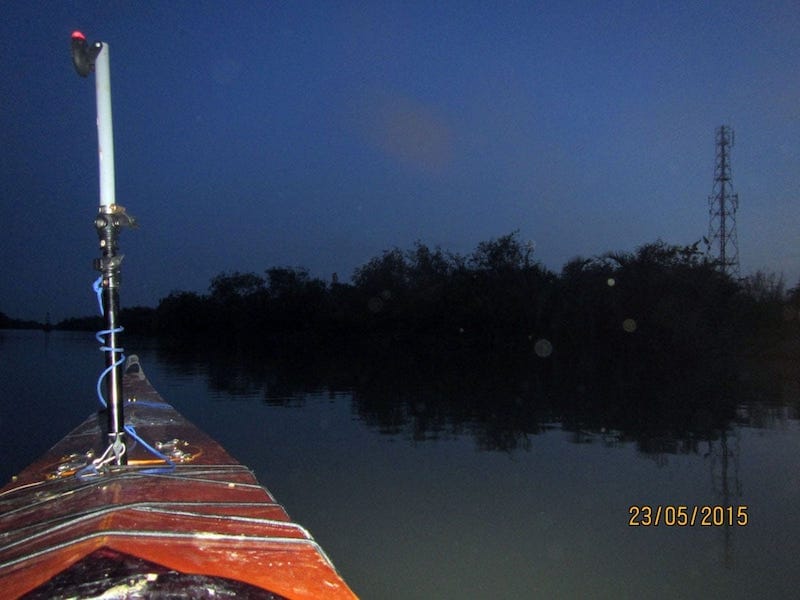
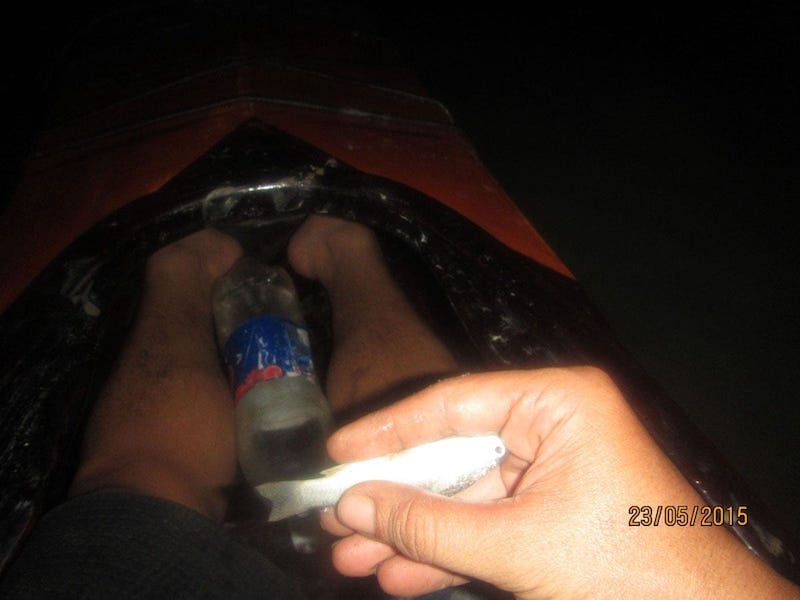
Nhiều đêm đi chơi xuồng kayak, 4, 5 tiếng đồng hồ một mình chèo trong bóng tối mênh mông, không một ánh điện, không biết đâu là bến bờ, tuyệt nhiên yên tịnh. Hoàn toàn phó theo cảm giác vì không thể nhìn thấy gì, toàn những bóng đen mờ ảo, cũng đã quá thuộc sông nước quanh đây. Quả nhiên không sai đây chính là khung cảnh lửa chài, cây bến còn vương giấc hồ từng chứng kiến bao nhiêu tiền kiếp về trước.

Rồi những đêm rằm trăng sáng rạng ngời, cảnh quang thuyền một lá đông tây lặng ngắt, một vầng trăng trong vắt lòng sông thật hứng thú vô cùng. Chốn này dường tách biệt hẳn với hồng trần thị phi, an nhiên tự tại không còn biết hôm nay là của ngày tháng năm nào nữa. Nhìn lên nghĩ bụng chị Hằng chắc là lạnh lắm, rồi tự hỏi phải chăng đây là cõi trời nguyệt minh tinh hy, ô thước nam phi thủa nào!?

Lại đôi khi gặp phải luồng cá lớn, dài trên hàng cây số, cá rượt đuổi theo song song như muốn đùa vui cùng với chiếc thuyền, hàng ngàn hàng vạn con bé nhỏ vọt lên khỏi mặt nước, réo rắt như một trận mưa rào mùa hạ. Hàng trăm con như những mũi phi tiêu lao qua mui thuyền, nhiều con rớt cả vào trong khoang. Rồi bỗng dưng bắt gặp mình ngâm nga khúc huống ta vớt củi buông câu, lứa đôi tôm cá bạn bầu hươu nai…

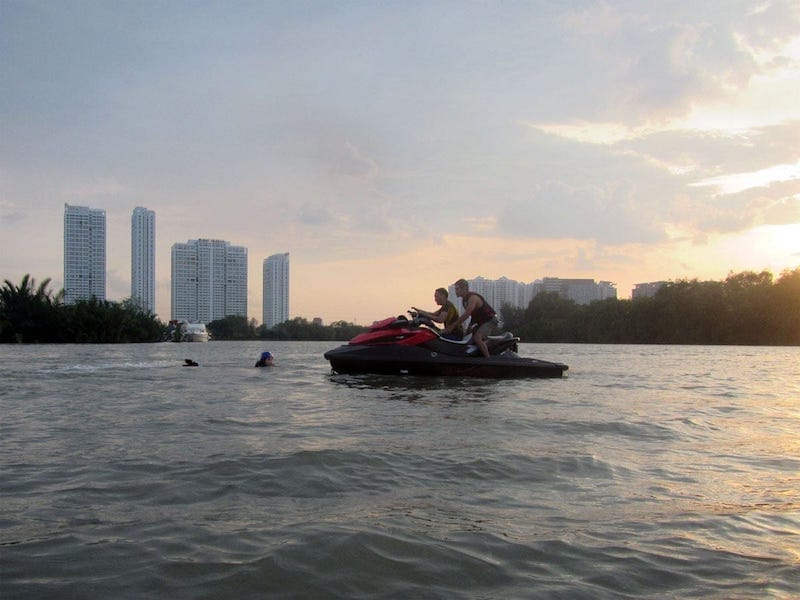
Cái sự khoái hoạt, phóng dật trong chốn giang hồ thật không một từ ngữ, không một bút mực nào gột tả hết cho được! Ghi lại vài dòng để còn gợi nhớ đến cảm giác, không gian này! Mở ngoặc nói cho rõ ràng rằng, từ nguyên, giang hồ – 江湖, đơn giản tức là giang – – sông và hồ – – hồ, nghĩa gốc vốn như thế, chỉ nơi sông nước, nhàn cư, ẩn dật… không phải hiểu theo nghĩa phái sinh của nó.

[ 1 ] Phượng hữu cao ngô, hạc hữu tùng, Ngẫu lai giang ngoại ký hành tung…, trích bài Ngạc Châu ngụ quán Nghiêm Giản trạch – Nguyên Chẩn.