bắc hành – 2015, phần 4

Gối đầu trên Lào Cai, Việt Trì,
Em nằm tóc xõa bãi cát dài,
Thả hồn mơ tới Thái Bình qua Sơn Tây.

Tiếng sông Hồng, Trường ca Hội trùng dương - Phạm Đình Chương 

Lên đến Sapa một ngày rét đậm, hôm đầu tiên chứng kiến ngay một trận mưa đá, những giọt nước đóng băng bằng cỡ hạt đậu, rơi xuống đất rào rào bắn tung toé như muối hạt. Cũng có ý ở Sapa lâu một chút, hy vọng sẽ có tuyết… Chính giữa trưa mà cả thành phố chìm ngập trong biển sương mù. Những người dân tộc nhóm lửa sưởi bên nhà sàn, còn mình thì cứ tay trần lái xe từ giờ này sang giờ khác, mới biết những tháng ngày chèo thuyền cũng tương đối mang lại chút kết quả!

Người ta vẫn thường hay kháo nhau về những miền gái đẹp như ở huyện Than Uyên, tỉnh Lai Châu… Thực ra theo tôi, đó chỉ là một cách nói. Ở đâu đất đai rộng rãi, khí hậu tương đối ấm áp, có thể sản xuất được, đời sống không quá khó khăn, ở đâu sơn thuỷ hữu tình, núi non hùng vĩ, lòng người cũng khoáng đạt, rộng rãi như thiên nhiên vậy. Ở đâu hội đủ cả hai điều kiện vật chất và tinh thần nói trên, thì ở đó con người sẽ đẹp, gọi là miền gái đẹp cũng là đương nhiên, không có gì là lạ!

Năm ngoái đã thăm thú kỹ Sapa và các vùng phụ cận, năm nay chỉ ghé qua để đi lại vùng chân núi Hoàng Liên Sơn, phía bên kia đèo Ô Quý Hồ. Cảnh quan rộng lớn, núi non cao ngút choáng ngợp, thật là nơi mở rộng tầm mắt và lòng người. Cái cảm giác tay lái chênh vênh trên bờ vực thẳm, cảm giác mỗi người chỉ là một hạt cát trong thiên nhiên bao la… Con người ta sinh ra vốn là như vậy, không phải những thứ gian vặt, tẹp nhẹp, tủn mủn của cuộc sống thường ngày trong cái xã hội bây giờ.

hello world – 3, part 24

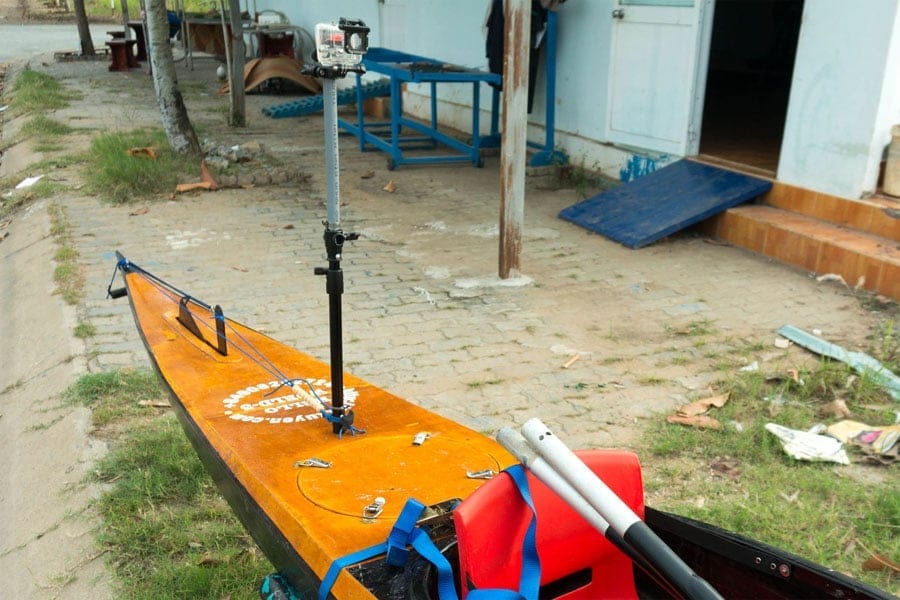
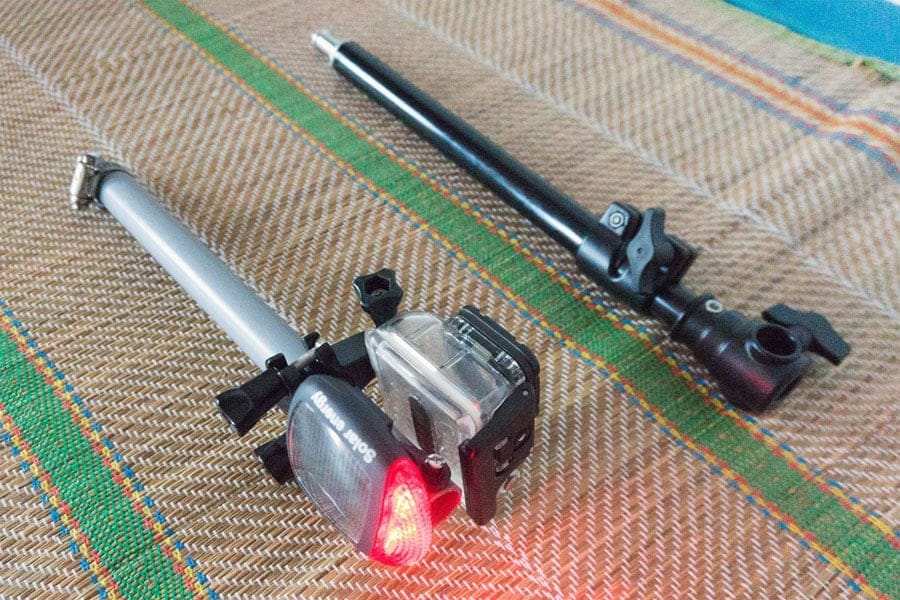
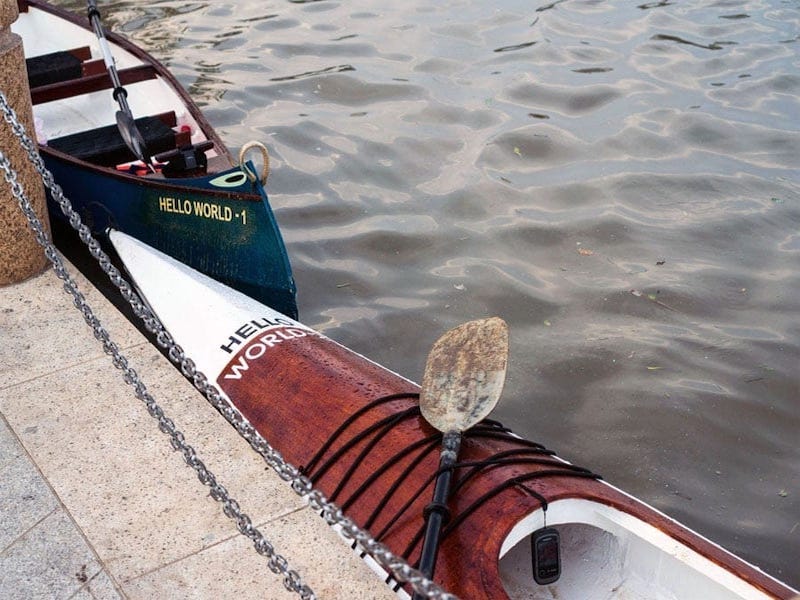
Last batch of updates for my kayak before Tết (Lunar new year), a detachable and retractable light (and camera) pole. At a bicycle accessories shop, I found a small signal light which uses solar cell (about 3 square inches in area). Testing the LED torch showed that after being fully charged, it could continuously blink for two nights, more than enough to be used for the boat. It has 4 blinking modes, which could be changed by a switch located behind.

The light is small, lightweight and most importantly, doesn’t need a separated battery since it uses solar energy (that means: less thing to be cared for in a journey). The pole, in its retracted position, is high enough for the signal light to be visible from other vessels on water. When the GoPro is in used, the pole is extended about one foot higher so that the camera could get a better view ahead of the boat. And the whole thing could be used, as a… selfie stick when needed.

Screw off the pole from the connecting dock bolted down to the aft deck, attach my other Canon D30 camera to the end, then I have a selfie stick in hand. Well, I’ve been concentrating more on boats and paddling, not the photography things, but it’s better being able to capture the beautiful scenes along the paddling way anyhow. There’re still many things to be done for the kayak, but that would be until the next year. For now, just more and more paddling, 25 km every 2, 3 days or so.

May the new year comes for me with more will and determination to reach my dream target. The more I understand about the task, the more challenging I’ve realized how it would be, for now, I’m not sure still if I could make it: lots of practicing and preparing, a huge deed of efforts and endurance required to make that 300 km (6 ~ 7 days or more) journey. May the new year comes with more internal calm and balance, for me to live wholly in this simplicity and purposefulness.

hello world – 3, part 22

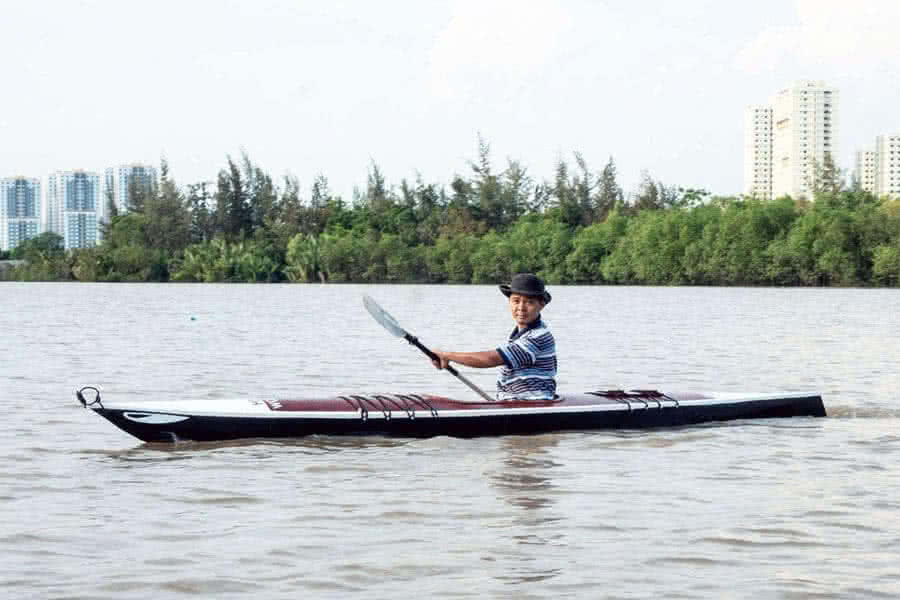
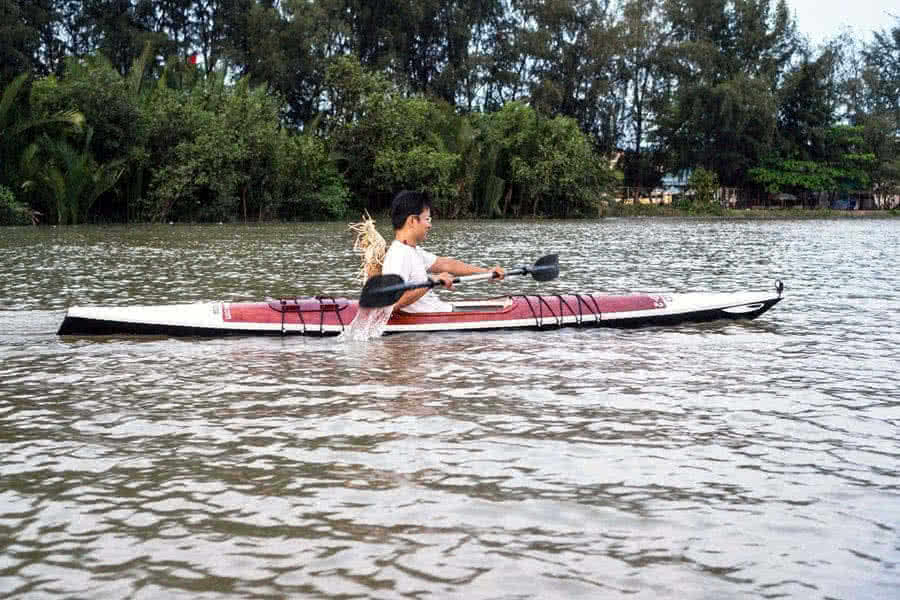
Having made some more thorough testing, I’m now feeling very pleased with the new boat and its build quality. After several 20 ~ 25 km paddling trips, I think I can average out at 7 kmph for extended time (5, 6 hours) and probably longer with more endurance exercising. That’s still not up to my expectation yet, but about speed, on the internet, you can hardly find trustable reporting on kayak and its paddler’s abilities, some boating information is purely… bloating!

At some points, due to the lack of correct information, I did have some illusions on paddling speed. But now I definitely know that a typical good sea kayak has the average, sustainable speed in the 7 ~ 7.5 kmph range. Beyond that would be the domain of racing kayak or surfski, which could step into the 8 ~ 9 kmph range, the best of which could not reach too far beyond 9 kmph. And that probably would be the target of my next build, though currently I have no plan for it yet.

Unlike HW – 2, I feel very comfortable to paddle HW – 3 into the wind. The hull pierces waves nicely, and I think the boat would surf well also. Haven’t had the chance to trial the kayak in big standing waves, but in some lesser situations, I’d noticed that the boat rides waves in style, with very little drifting, shaking. That’s a characteristic very much needed when I would leave the relatively – calm rivers to go into the much more choppy areas of coastal sea and large estuaries.

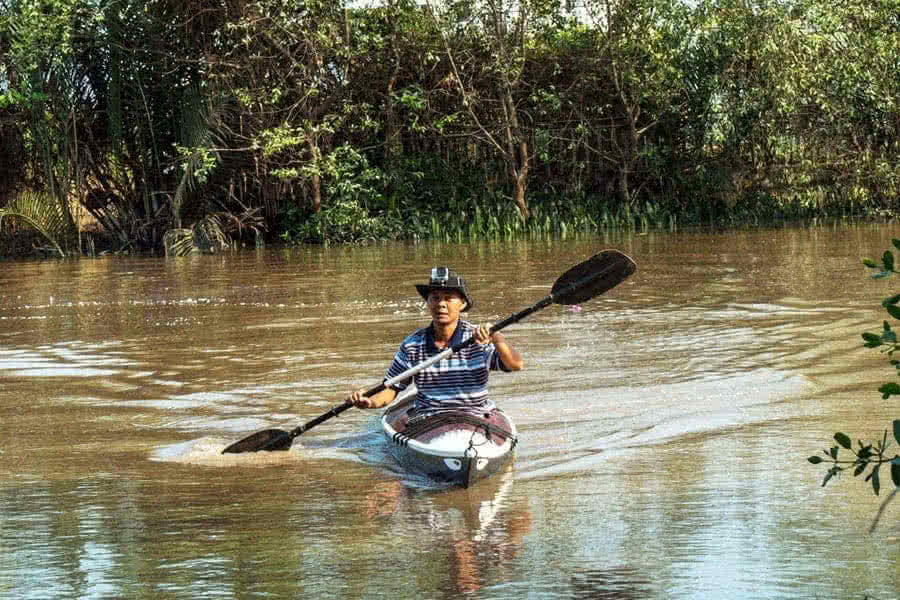
It’s approaching year end and I’ve got lots of other stuffs to do, so there won’t be any big updates to the kayak until next year. It’s a real pleasure when on rivers, people was asking where I bought the boat from, and when I told them that I built it myself, none believes it! This season, day temperature is dropping below 25°C (that’s already called “cool” for a tropical Saigon), good for going paddling indeed. Some video shots to show the boat, captured with my GoPro mounted at bow.

vũng tàu, june 2014

This has been in my TODO list for quite some time, but for various reasons, couldn’t get it done till now. To the present day, I’ve accumulated more than 1,000 nmi under my belt with Hello World – 1 & 2 (nearly 1,900 km, as logged by my Garmin), but that’s only the 20 ~ 25 km paddling around my home. I need something longer to testify my endurance; and for the last 2 months, I’ve been preparing for this 60 km paddling trip to Vũng Tàu: physical exercising, equipments, plan A, plan B, etc… It just comes the time to… get your paddles wet!

My Hello World – 2 kayak is a true player on rivers, but it’s surely no performer at sea. A 14 footer, it’s quite unsuitable to be deployed on longer journeys, so I need to make careful planning. The trip will be completed in 3 legs, approximately 20 km each, the first 2 will follow Sài Gòn and Lòng Tàu rivers, the last leg would pass Gành Rái bay to reach Vũng Tàu on ‘open sea’. And indeed, I have no ‘plan B’, no camping gears, no food and drink for a 2nd day of paddling, no signaling devices… it just has to be done, 60 km in a single day, in a single try!

Leg 1

Wake up at 3:30 AM, I carefully check the gears, load the kayak, have a big breakfast, and at 4:30 AM, I depart. Right at the first paddling stroke, it begins to rain, cats and dogs! And it continues to rain lightly for the next several hours, but that’s good really. Silently pass by many fishing boats, some was sleeping, some was watching a FIFA World Cup’s live football match! Heavily loaded, I make my way through the misty, dark water with a pace around 6 ~ 6.5 km/h. At 5:30 AM, the Garmin indicates a minor rise in speed, ~ 7.5 km/h, it’s the tide’s coming into play!

6:00 AM, as the dawn was breaking, I steadily made 8 ~ 9 km/h, 6:45 AM, I was making a comfortable 9.5 ~ 10.5 km/h riding. The tide plays quite a role in my planning, it should help to conquer the first 2 legs as fast as I can, reserving stamina for the last troublesome leap. Velocity then increases to 11 km/h for a short while, momentarily reaches 12 km/h, woohoo… I finished the 1st leg in 3 hours with little resting time, reaching Tam Thôn Hiệp crossroad, the southern most outskirt of Sài Gòn, beyond this point is Cần Giờ mangrove biosphere reserve.

Leg 2

8:00 AM, after a short break, I start the 2nd leg, which traverses the Cần Giờ mangrove forest to reach the sea. The Garmin instructs me confidently through this complex maze of rivers and canals, making ‘bip – bip’ sound in approximation of each turn point (the planned route was made on computer and transferred to the device). I’m a bit in hurry as I know I don’t have a large time frame to utilize the tide, in all, less than 4, 5 hours or so. 8:30 AM, the tide will finish lowering in Vũng Tàu area, though for inland water, there’s still a delay effect.

Speed drops gradually along this 2nd leg, and at 10:00 AM, I was returning to 6 ~ 6.5 km/h, as the tide was coming to a complete stop. The last few kilometers of this leg was a bit difficult, cause although my arms and shoulders showed little sign of tiredness, my butt was in great pains after hours of idleness. Then it was a moment of thrill, to stand here and watch over the large calm estuary where the river joins the sea! Another leg done, an hour of resting, lying leisurely in the boat, watching the sea, having lunch, and making some selfies!

Leg 3

Right at noon, I start the final leap. I was having a good day, it’s heavily cloudy, the sea is quite calm, small waves, south – west light wind at 2, 3 on Beaufort scale coming to my convenience from starboard ‘broad reach’ or ‘beam reach’, Vũng Tàu‘s mountains are clearly visible across the big bay. I decided to start as soon as I can, fearing the regular afternoon tropical gales and rains could bring much trouble later on. Switch the Garmin to compass mode, keep the bearing at 125 degrees for several hours, this gonna be just a piece of cake!

The following hours turned out to be not easy indeed! I begin to feel pains for my hands, the waves have hampered my efforts and reduced speed into the 4.5 ~ 5.5 km/h range. I have not a single moment of worry, but rather a kind of tranquility in my mind while navigating this immense sphere. I stop for a while having an nice talk with a local fisherman, then keeping on the straight line to target. On starboard side then seen the Cần Giờ Aval lighthouse (Vietnamese: hải đăng Bóng Trắng). Then at 4:30 PM, landed in Vũng Tàu at the precise pre – planned spot.

Return

Terra firma eventually, my 12 hours of paddling completed with flying colors! Nothing more to expect for the day, I go for dinner, then back to the hotel and have another 12 hours of sleep! Next morning, I was messing around the harbors, watching the fishing boats, then at noon, load my kayak onto a rented truck and return to Sài Gòn. My arms are still having some little pain as I’m typing this, but the feeling is really pleasant. It could be a small thing to others, but a little real achievement for me! Another milestone in my boating progress!

The trip helps rectifying some defects and shortcomings on boat building and boating equipments. It’s only in these longer trips that I would find out what gears, food, drink, clothing, etc… should I have, what improves and accessories I could do for my boats. Yet Hello World – 2, at 14 feet, still belongs to the recreational class, it’s not a real expeditional sea kayak by design… The trip also helps consolidating my understanding and experiences on what I should prepare to make successful future sea crossings and longer passages into mare liberum.

Epilogue

The Sài GònVũng Tàu route is crowded in maritime traffic, big boats from a few thousand to a few dozen thousand tons come and go every few minutes. It’s a real risk that your tiny boat could be overseen and overrun by those giants, as I was ‘near – missed’ by a huge freighter at great speed by just 50 ~ 70 m in one case. I should have an VHF radio to communicate with them to avoid collision. The waves created by those boats, though could be as high as 1 ~ 1.5 m, are not dangerous actually, as they are well patterned and well behaved.

Routes plotted with Google Earth: planned route in blue, actual route in red. Some GPS logged data: distance travelled: 58.4 km, total time: 11:31′, paddling time ~ 9:00′, resting time ~ 2:30′, I averaged out only 5.08 km/h over all. Obviously, there’s still lots of things to be improved here!

Another aspect of paddling in tropical weather: the ‘thermal efficiency’ of your body (like any other machines or engines) would degrade badly in the 30 ~ 38°C temperature range, you’ll need lots of water (and food) to keep up the pace, a sunny day could easily use up 3, 4 litters just for drinking (not to include cooking). That could cause a ‘logistical problem’ as a kayak has limited storage capacity, it could be a headache to prepare food and drink rations (among other things) for a 4, 5 days trip, the heavier the load, the slower the boat of course.

Some video scenes of the trip captured with my GoPro camera.

Vũng Tàu is no stranger to me, having visited it many times before. But this time is different, a chance to view the city from another perspective. For many moments, I thought I had quite some illusions of grandeur, the literal, optical meaning, as the sceneries appear as in tilt – shift photography: people, houses, cars, boats, the trees… all appears to be so small under the blue sky, even the mountains do not look really big… A fantastic feeling when you observe the little city of Cap Saint Jacques from the back of waves, some distances off from shore.

a bit of roughness

A typical small tropical gale during this rainy season… winds can momentarily reach up to level 5, 6 or more on Beaufort scale. It can get pretty rough at time right here on Saigon river and without a spray skirt, the kayak takes on water easily in this weather, when filled up about 1/3 of the volume, the boat is heavy to paddle, it becomes less responsive and easier to take more water in. I need to pump the water out several times during my routine 20km paddling trip.

But it’s also fun, the rougher it get, the tougher you need to be!

saigon river

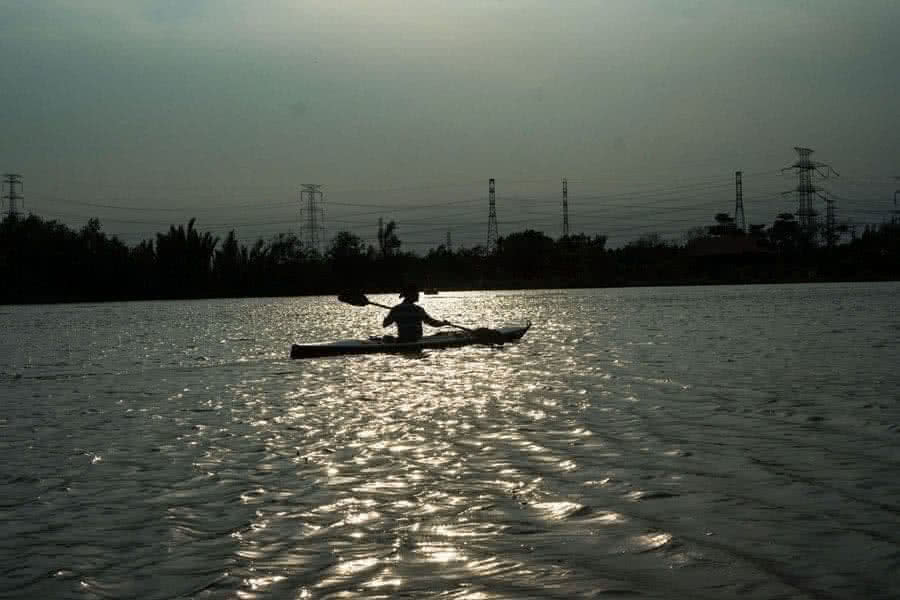
It is not always as calm as in the video below, this time of the year, the monsoon is reversing, causing lots of turbulences. Sometimes waves are so big that I can hardly have anytime for playing around with my GoPro camera, one reckless moment could cause my little kayak to be flooded, or worse, capsized. But many of the times, there’s enough wind and wave to let Hello World – 2 going dancing, drifting and surfing. My 20km routine paddling path, passing by Phú Xuân bridge, Nhà Bè fuel reservoirs, Bình Khánh ferry, Hải Minh shipyard… where I can see the CSB – 9001 (a Vietnam maritime police’s search and rescue boat) mooring, next to it are some small Navy (HQ – xxx) gunboats.

In the wet docks are two Navy minesweepers: HQ – 863, HQ – 864 being refitted, I passed by closed enough to see their towed array sonars and their wooden planks (minesweepers are rarely constructed in ferromagnetic materials, often it’s wood or composite). The two hulls: KN – 806, KN – 807 are barely finished with some upper structures, they belong to Kiểm Ngư (Vietnam fisheries resources surveillance) force, whose establishment has just been announced last week. There’re also some other exotic – looking water crafts, which I haven’t been able to identify their designs and roles. No active guard seen for the Navy shipyard, or they don’t even care about my harmless tiny nutshell!

hello world – 1 and 2

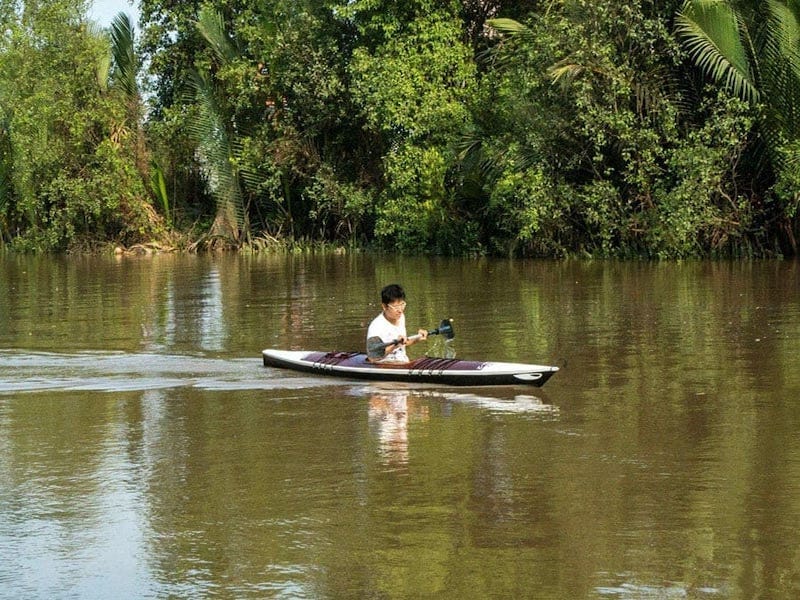
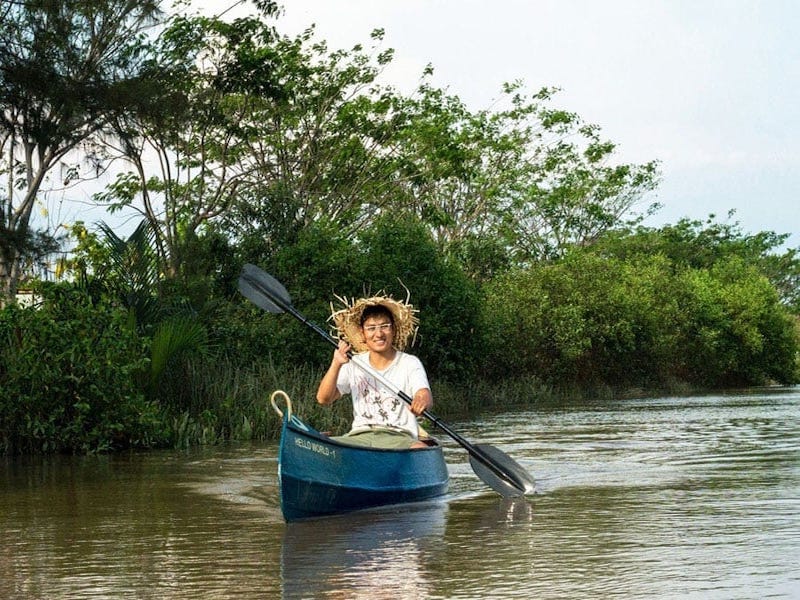
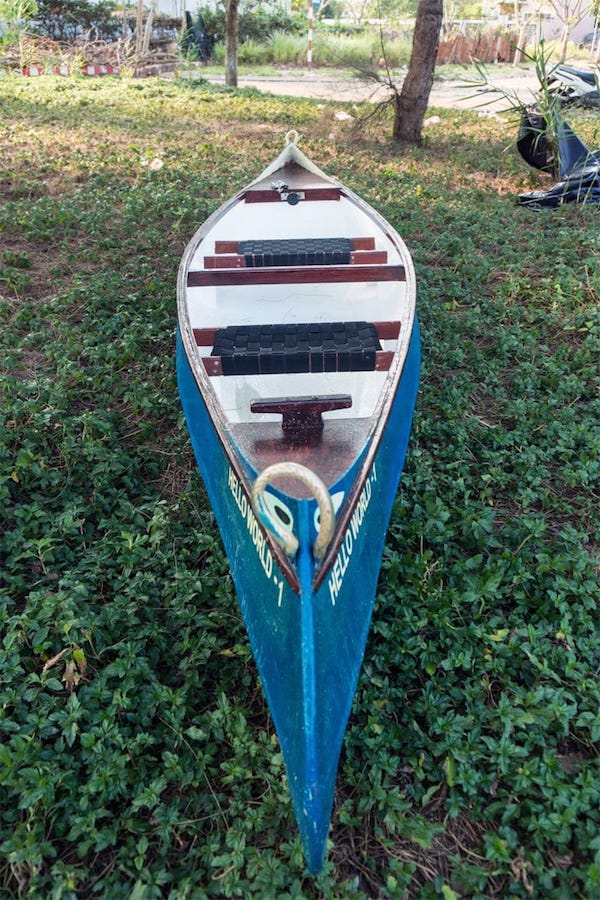
Now “operating two boats”, I could have more ways to play and have fun with them. Usually, me and one of my friend, each of us would go on a separate canoe / kayak, then exchange them at the midpoint of a paddling trip. It’s extremely hot out there this season, 35° ~ 39° Celsius, but that’s good for our endurence anyhow.

The handling experiences are different from boat to boat, and obviously, Hello World – 2 is lighter and has much better speed compare to Hello World – 1. It can easily give a handicap of more then 1/3 of the way. But despite of that, it’s good to learn how to handle both boats, in various conditions and situations on water.

Below is a video capturing both 2 boats’ actions on water, each as looked from the other. While Hello World – 2 was taking a gentle promenade, Hello World – 1 had to struggle hard to keep up. Jump to 1’36” on the video timeline to see how the kayak made a fast, short impressive sprint to approximately 7 ~ 8 knots!

hello world – 2, part 3

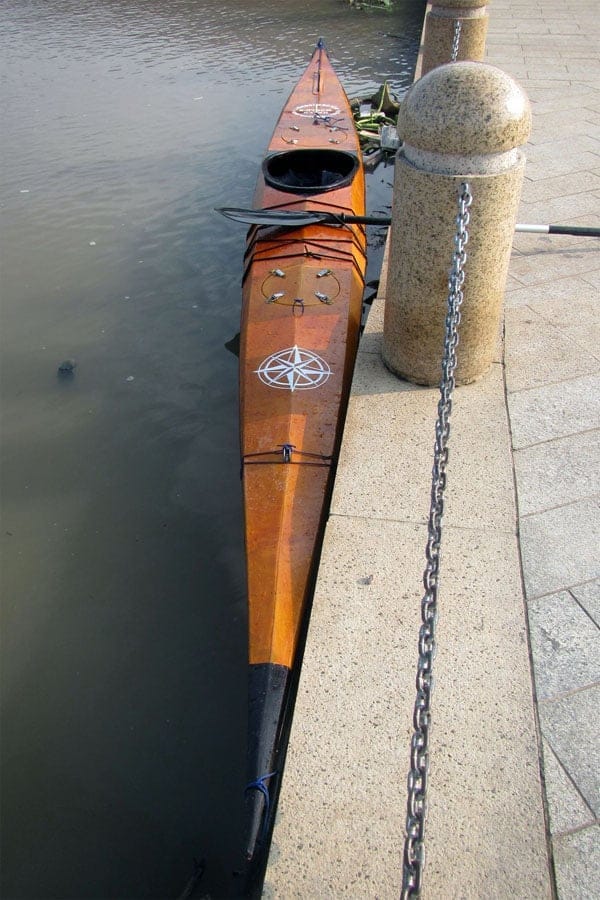
Launched and trialled the kayak this April fool day! Can’t say how much I’m pleased with it, great speed, just like a dart slicing through water! It could take some time to learn how to handle this new kayak, the experiences are different between my two boats, but I got the right feeling on how to control it very soon.

The boat gave me a good firm sense that it can be used for longer range. The 2.2 m paddle is too long for this 0.62m – beam kayak, I would need to make a new 1.9 ~ 2.0 m one, but that would be later. I need to try it out thoroughly before deciding what to do to turn it into… an “expeditionary” boat for my up – coming journeys!

Made some longer paddling and realized the boat’s tendency not to track very straight under turbulent flow or wind (in calm conditions, it tracks well), this is tiresome for long voyage. This could be fixed when the kayak is fully loaded, with weight shifts toward the aft, but I decided anyhow to add a retractable skeg to the boat in the coming weeks!

follow me

First of the three images, could it be called a “Follow me” style!? So busy lately, but keep paddling an average of 20km every two days, don’t actually have time to raise the target at 25, 30 km yet. February is short, can’t wait until all the rowing stuffs get done!

It’s now “kite – flying season” for the kids, plenty of wind these days on the rivers. And it’s also the “practising – season” for me, lots of windage for my small boat. It can even get quite rough at times, and you’d need to be tough, harder and harder paddling, day by day!

Imagine the 4, 5 feet (or more) waves out there in Vũng Tàu, much more troublesome and fascinating, compared to the 1, 2 feet waves here on the rivers, which couldn’t really give me a sense of motion. For various reasons, boating works have been delayed and delayed again, sigh…

a watery saigon – 1

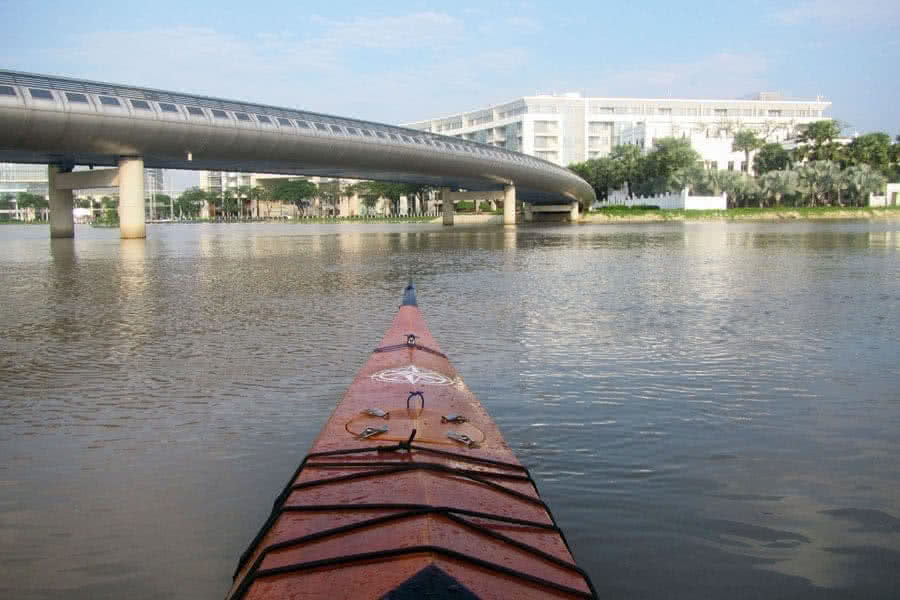
Made my first “departure” on this first day of the new year 2014, year of the horse; a 20 km paddling roundtrip. I want to see more of that same city, from a different point of view, not that usual view of most of the 20 – years – long living here. There is another completely different Saigon, a Saigon seen from water, as on flat land, for the most part, it’s a messy city. It took me a long time to get accustomed to its main roads, especially in the southern parts, as they usually turn around and around, forming untidy, complex, bizarre networks. But if you see them from the waterways perspective, the topologies immediately become clear and easy. That reminds me the essential geo – ecological things about this southern young, energetic city…